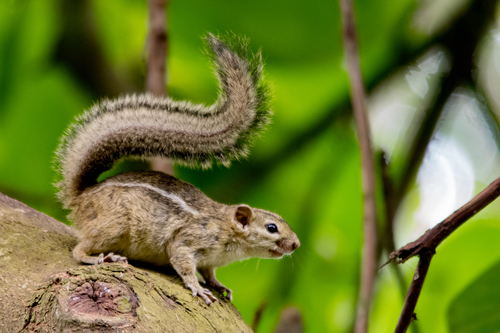
About Spermophilus citellus (Linnaeus, 1766)
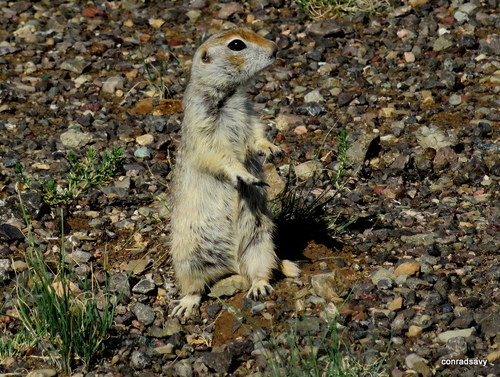
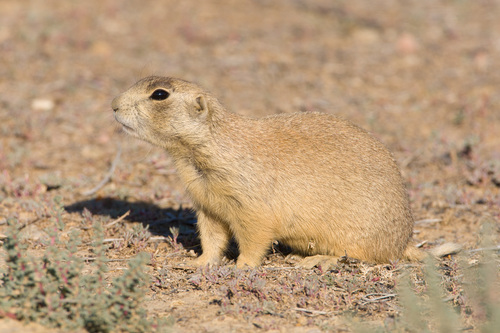
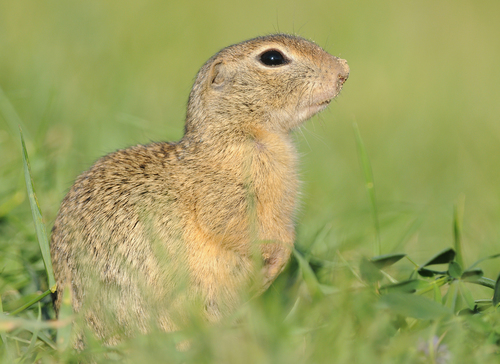
Description: The European ground squirrel (Spermophilus citellus) is around the size of a brown rat. Adults measure 20 to 23 cm (8 to 9 in) long, and weigh between 240 and 340 g (8.5 to 12.0 oz). It has a slender body and a short, bushy tail. Its short, dense fur is yellowish-grey with a red tinge, and the back has a small number of faint pale and dark spots. The underparts are pale, and the abdomen is sandy-colored. Its large, dark eyes are set high on the head, and its small, rounded ears are concealed within its fur. Its dental formula is 1.0.2.3 / 1.0.1.3. It has powerful legs with sharp claws that are well adapted for digging. Males are slightly larger than females, but the two sexes are otherwise similar in appearance. This squirrel has a shrill alarm call that prompts all nearby individuals to retreat into cover. It also produces a range of softer chirruping and growling sounds. The European ground squirrel can be mistaken for the speckled ground squirrel, which is found in Poland's Lublin Voivodeship, Moldova, Russia, Belarus, and Ukraine. The speckled ground squirrel differs by having dark brown fur spotted with white, a thin tail, and a preference for areas with coarser vegetation. Distribution and habitat: The European ground squirrel is native to central and southeastern Europe, where its range is split by the Carpathian Mountains. It can be found at altitudes up to 2,593 metres (8,507 ft), and its range covers southern Ukraine, Asia Minor, Austria, the Czech Republic, Slovakia, Serbia, Hungary, Greece, Romania, Moldova, Bulgaria, North Macedonia, and extends north as far as Poland. It became locally extinct in Germany and Poland, but was successfully reintroduced to the wild in Poland in 2005; some of the reintroduced individuals were sourced from Budapest Ferenc Liszt International Airport. The European ground squirrel has very specific habitat needs: it requires short grass to dig its tunnel system. It finds this habitat type on steppes, pastures, dry banks, sports fields, parks, and lawns. Suitable habitat is lost when agricultural changes convert grassland to arable land or forest, or when grazing stops, allowing grass to grow coarse and scrubland to develop. Other sites with short vegetation that can sometimes provide suitable habitat include railway embankments, road cuttings, and road verges.