About Spatula querquedula (Linnaeus, 1758)
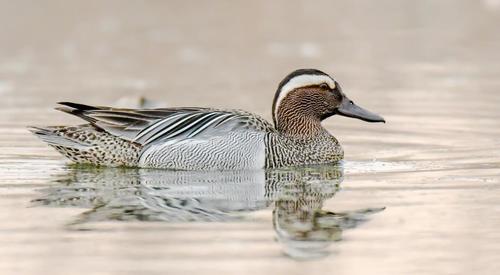
This species has the scientific name Spatula querquedula (Linnaeus, 1758), and is commonly known as the garganey. Adult males are easily identifiable: they have brown heads and breasts, with a broad white crescent marking above the eye. The rest of their plumage is grey, and they have loose grey scapular feathers, a grey bill, and grey legs. Their crowns are dark, and their faces are reddish brown. In flight, males display a pale blue speculum edged with a white border. When swimming, they show prominent white edges along their tertials. Extra care is required to distinguish brown female garganey from the similar common teal. Two good identifying features for female garganey are their stronger face markings and more frequent head-shaking while dabbling. Female garganey can also be confused with female blue-winged teal, but these two species differ in head and bill shape, and blue-winged teal have yellow legs, unlike garganey. Female garganey have a pale eyebrow, a dark eye line, and a pale lore spot bordered by a second dark line. Standard measurements for the species are: overall length 41 cm, wingspan 58–69 cm, and weight 300–440 g. Garganey feed mainly by skimming rather than upending. Males have a distinctive crackling mating call, while females are unusually quiet for female ducks, though they can produce a feeble quack. Garganey are rare breeding birds in the British Isles. Most breeding pairs in this region nest in quiet marshes of Norfolk and Suffolk. In Ireland, a small number of pairs breed in County Wexford and at Lough Beg in County Londonderry, with occasional breeding recorded in other locations. The garganey is one of the species covered by the Agreement on the Conservation of African-Eurasian Migratory Waterbirds (AEWA), and it is classified as least concern on the IUCN Red List.