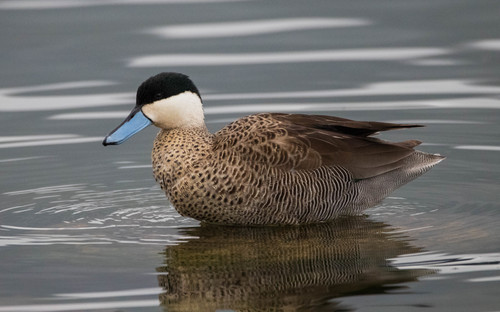
About Spatula puna (Tschudi, 1844)
The Puna teal, with the scientific name Spatula puna, is a dabbling duck species that belongs to the family Anatidae. It was once classified as a subspecies of the Silver teal, Spatula versicolor. This is a non-migratory, resident species native to the Neotropical realm of South America. It lives in the Andes, with a range confined to the Puna zone extending from central Peru’s Junín region south through western Bolivia, northern Chile as far south as Antofagasta, and into the extreme northwest of Argentina’s Jujuy Province. It occupies the larger lakes and pools of the altiplano, and is restricted to high-altitude environments, typically found at elevations up to 4,600 m (15,100 ft). It inhabits a variety of freshwater wetland types, and favors weakly alkaline lakes, swamps, and bogs that have abundant floating vegetation, especially aquatic plants from the genus Chara. Its conservation status is listed as Least Concern on the IUCN Red List. For breeding and reproduction, Puna teals usually reach breeding maturity and have their first breeding event at one year old. The species is mostly monogamous, though some males practice some degree of polygyny and engage in extra-pair copulations. In the wild, they live either in single pairs or in small groups, which may contain only Puna teals or be mixed with Silver teals. They nest on the ground in rough vegetation like long grass, and nests are not always located close to water. Egg laying occurs between April and June. Their eggs are creamy pink in color, and clutch size ranges from 5 to 8 eggs. Chicks typically weigh around 25 g when they hatch. Females incubate the eggs alone for approximately 25 days. Like swans and geese, both parents help rear the ducklings. Males accompany the brood and defend the female during the fledging period, and the pair bond between a male and female may be long-term.