About Spatula hottentota (Eyton, 1838)
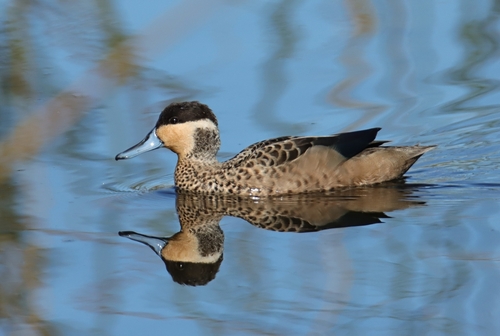
Scientific name: Spatula hottentota (Eyton, 1838), commonly known as the blue-billed teal.
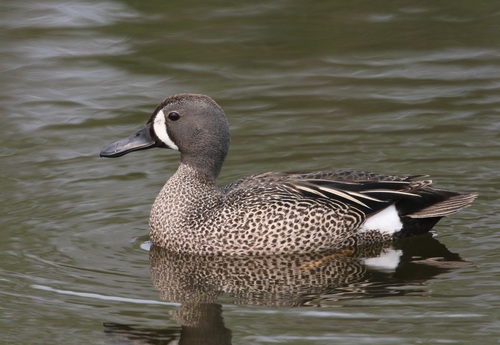
Identification: Adult males have a dark brown crown that contrasts with a paler face, throat, breast, and sides, except for a blackish thumb-shaped patch on the ear region. The back of the neck is spotted with black, and this spotting extends down through the neck, becoming more intense on the breast. Spots are larger and less obvious on the light brown flanks and abdomen, while the posterior underparts and undertail coverts have black vermiculation. Scapulars and the tail are dark brown to black, and the upper wing surface is also blackish, with wing coverts that carry a greenish gloss. An iridescent green speculum is present on the secondaries, bounded posteriorly by narrow black and terminal white bars. The iris is brown, legs and feet are bluish grey, and the bill is light bluish grey with a blackish culmen and nail. Females have browner crowns, less contrasting facial markings, more rounded scapulars, non-vermiculated undertail coverts, and a wing that is less glossy and colourful than the adult male’s. Juveniles resemble adult females but are duller across their entire body and have less distinct spot markings. Ducklings have greyish brown upperparts, yellowish grey underparts, paler cheeks with a soft pink wash, and a grey-brown ear patch. See External Links for external duck anatomy.
Distribution and habitat: In Africa, the blue-billed teal’s range includes Angola, Zambia, eastern Congo, Malawi, northern Mozambique, Tanzania, Kenya, Uganda, southern Ethiopia, Sudan, and Madagascar. It is mainly found in tropical eastern Africa from Ethiopia to Cape Province, westward to northern Botswana and Namibia, as well as in Madagascar. The blue-billed teal prefers habitats with abundant floating-leaf plants and fringe vegetation, including shallow freshwater swamps, marshes, streams, shallow small lakes, and ponds edged with reeds or papyrus. It dabbling in very shallow waters during twilight and night, and moves to deeper, safer parts of the marsh during daytime.
Social behaviour and reproduction: The blue-billed teal’s breeding behaviour is relatively undemonstrative. Based on current research, the pair bond does not last beyond the female’s incubation period, so the bond is thought to be re-established annually. While most breeding occurs in summer, this species also breeds in winter, meaning courtship behaviour can be observed year-round. The most common courtship display combines female inciting and male head-back turning. Females incite males by making lateral movements silently or nearly silently, and males usually respond by swimming ahead and turning the back of their head. Males may also respond by drinking, or by raising their neck vertically and producing a soft mechanical series of call notes (called burping); they sometimes combine these two displays in a burp-drinking sequence. During social display, ducks frequently perform a sequence of wing-flapping followed by a both-wing-stretch, which appears to be an important part of the display. Pre-copulatory behaviour consists of mutual head pumping, and post-copulatory male displays vary from no noticeable activity to a swimming shake, wing flapping, or burping. Females most often only bathe after copulation. Clutch size for this species ranges from 6 to 8 eggs, with 7 being the most common number. However, based on Clark’s observations on the Witwatersrand, broods of ducklings range from 1 to 7, with 3 being the most common. Incubation takes 25 to 27 days for naturally incubated clutches. Males may stay nearby while females incubate, but there is no evidence that males participate further in brood rearing. As far as is known, the species is not multiple-brooded, though nest failure can lead to re-nesting.