About Spatula discors (Linnaeus, 1766)
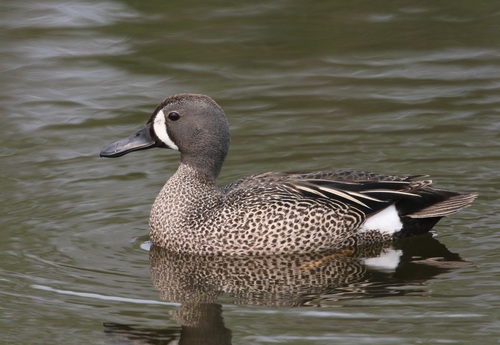
The blue-winged teal, Spatula discors, measures 40 cm (16 in) in length, has a 58 cm (23 in) wingspan, and weighs an average 370 g (13 oz). Adult males have a greyish blue head with a white facial crescent, a light brown body with a white patch near the rear, and a black tail. Adult females are mottled brown with a whitish area at the base of the bill. Both sexes have sky-blue wing coverts, a green speculum, and yellow legs. Blue-winged teals have two molts per year, plus a third molt during their first year. Males produce a short whistle as a call, while females make a soft quack. The species’ overall range covers almost all of North America, excluding western and northern Alaska, northern Yukon Territory, the northern Northwest Territories, and northeastern Canada. It is rare in the desert southwest and along the west coast. Its breeding habitat is marshes and ponds, and its breeding range extends from east-central Alaska and southern Mackenzie District east to southern Quebec and southwestern Newfoundland. In the contiguous United States, it breeds from northeast California east to central Louisiana, central Tennessee, and the Atlantic Coast. The western blue-winged teal occupies the portion of the breeding range west of the Appalachian Mountains. Some blue-winged teal populations nest along the Atlantic Coast from New Brunswick to Pea Island, North Carolina. Blue-winged teals migrate in flocks to winter south of their breeding range, and some individual birds may fly long distances over open ocean during migration. They are occasional vagrants to Europe, where their yellow legs distinguish them from other small ducks such as the common teal and garganey; in recent years, they have been annual vagrants in Britain and Ireland. They winter from southern California to western and southern Texas, along the Gulf Coast to the Atlantic Coast, throughout the Caribbean, and south into Central and South America, and are regularly seen wintering as far south as Brazil and central Chile. Blue-winged teals are more commonly found along shorelines than in open water, and prefer calm water or sluggish currents over fast-moving water. They inhabit inland marshes, lakes, ponds, pools, and shallow streams with dense emergent vegetation. In coastal areas, breeding takes place in salt-marsh meadows adjacent to ponds or creeks. They rest on rocks that protrude above water, muskrat houses, trunks or limbs of fallen trees, bare stretches of shoreline, and mud flats. During winter, they occupy shallow inland freshwater marshes as well as brackish and saltwater marshes. They build their nests on dry ground in grassy sites including bluegrass meadows, hayfields, and sedge meadows, and will also nest in areas with very short, sparse vegetation. Nests are generally located within several hundred yards of open water, though some have been found as far as 1.61 km (1 mi) away from water. They will nest communally in high-quality habitat. Blue-winged teals often use dense stands of bulrushes and cattails as escape cover. Nesting cover is provided by grasses, sedges, and hayfields. Researcher Erik Fritzell found that blue-winged teal nests in light to sparse cover had higher success than those in heavy cover; nesting success was 47% on grazed areas and 14% on ungrazed areas. The blue-winged teal is primarily found in the northern prairies and parklands, and is the most abundant duck in the mixed-grass prairies of the Dakotas and the prairie provinces of Canada. It is also found in wetlands within boreal forest associations, shortgrass prairies, tallgrass prairies, and deciduous woodlands. It commonly lives in wetland communities dominated by bulrush (Scirpus spp.), cattail (Typha spp.), pondweed (Potamogeton spp.), sedges (Carex spp.), widgeongrass (Ruppia maritima), and other emergent and aquatic vegetation. During molting, it often stays among large beds of bulrushes and cattails. For nesting, it favors areas dominated by bluegrass (Poa spp.), and hayfields as well as plant communities of buckbrush (Ceonothus cuneatus) and sedges are also important nesting sites. Courtship among immature blue-winged teal usually begins in late January or early February. Blue-winged teal are more active in courtship during spring migration than most other duck species in areas south of the breeding grounds. They are among the last dabbling ducks to start nesting, generally nesting between April 15 and May 15. Few nests are initiated after mid-July, and nesting timing can vary from year to year due to weather conditions; at Delta Marshes, Manitoba, blue-winged teal nesting was delayed by one week in 1950 due to uncommonly cold weather. The nest is a shallow ground depression lined with grass and down, usually surrounded by vegetation. Blue-winged teals generally lay 10 to 12 eggs per clutch. Delayed nesting and renesting attempts produce substantially smaller clutches, averaging five to six eggs. Clutch size also varies with the age of the female: yearlings tend to lay smaller clutches. Incubation lasts 21 to 27 days. Blue-winged teals reach sexual maturity after their first winter. During incubation, the male leaves its mate and moves to appropriate molting cover, where it becomes flightless for 3 to 4 weeks. Blue-winged teal ducklings can walk to water within 12 hours after hatching, but do not fledge until they are 6 to 7 weeks old. Blue-winged teals are surface feeders, and prefer to feed on mud flats, in fields, and in shallow water that contains floating and shallowly submerged vegetation plus abundant small aquatic animal life. Most of their diet is vegetative matter: seeds, stems, and leaves of sedge, grass, pondweed, smartweed (Polygonum spp.), duckweed (Lemna spp.), widgeongrass, and muskgrass (Chara spp.). They actively eat seeds of mudflat plants including nutgrass (Cyperus spp.), smartweed, millet (Panicum spp.), and rice cut-grass (Leersia oryzoides). One quarter of the food blue-winged teals consume is animal matter, including mollusks, crustaceans, and insects.