About Spatula clypeata (Linnaeus, 1758)
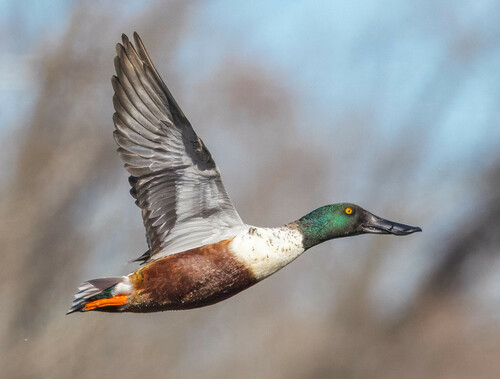
Northern shoveler (Spatula clypeata (Linnaeus, 1758)) is easy to identify in the northern hemisphere thanks to its large, spatula-shaped bill. Breeding males have an iridescent dark green head, which is less intensely iridescent than a breeding male mallard’s head and appears black at a distance or in low light. They also have a white breast, chestnut belly and flanks, and a black or very dark grey bill. When in flight, pale blue forewing feathers are visible, separated from the green speculum by a white border. In early autumn, males have a white crescent on each side of the face. In non-breeding eclipse plumage, males look similar to females, but still retain the pale blue forewing. Females are a dull mottled brown, just like other female dabbling ducks, with plumage similar to that of a female mallard. They can be easily distinguished by their long broad bill, which is grey with an orange tint on the cutting edge and lower mandible; the female’s forewing is grey. This species measures 44–52 cm (17.3–20.5 in) in length, has a wingspan of 70–84 cm (27.6–33.1 in), and typically weighs 500–800 g (1.1–1.8 lb), with rare individuals weighing as little as 300 g or as much as 1,000 g. Both sexes have bright orange-red legs. Vagrant northern shovelers in Australia are very hard to tell apart from the local Australasian shoveler, especially when they are in eclipse plumage and lack the distinctive white breast. Northern shoveler lives in open wetlands, including wet grasslands and marshes with some emergent vegetation. It breeds across large areas of Eurasia, western North America, and the Great Lakes region of the United States. This species winters in western and southern Europe, the Indian subcontinent, the Caribbean, northern South America, the Malay Archipelago, Japan, and other regions. Individuals wintering on the Indian Subcontinent cross the Himalayas on an arduous journey, often stopping to rest in wetlands just south of the range before continuing further south to warmer areas. In North America, it winters south of a line running from Washington to Idaho, and from New Mexico east to Kentucky; it also winters along the Eastern Seaboard as far north as Massachusetts. In Great Britain, around 1,300 to 1,450 pairs breed, but the species is better known as a winter visitor. It is more common in southern and eastern England, especially around the Ouse Washes, the Humber, and the North Kent Marshes, and occurs in much smaller numbers in Scotland and western parts of England. It breeds across most of Ireland, but the local population is hard to assess. Surveys conducted in 2017 and 2018 indicate that the species is more common and widespread in Ireland than previously believed. In winter, breeding birds from Britain and Ireland may move south, and their places are taken by an influx of birds from continental regions and Iceland further north. The species is strongly migratory, and most individuals winter further south than their breeding range. It has occasionally been recorded as a vagrant as far south as Australia, New Zealand, and South Africa. Outside of the breeding season, it is less social than some other dabbling duck species, and tends to form only small flocks. Among duck species native to North America, the northern shoveler is the third most abundant overall, outranked only by the mallard and blue-winged teal. Its population has remained stable and healthy since the 1960s, and has increased in recent years to over 5 million birds as of 2015. This increase is most likely due to favorable conditions in breeding, migratory stopover, and wintering habitats.