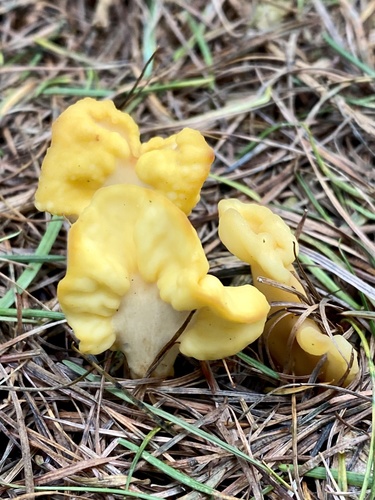
About Spathularia flavida Pers.
The fan- or spoon-shaped fruit bodies of Spathularia flavida can reach a total height of up to 8 cm (3 1/8 inches), though a typical height range is 2–5 cm (3/4–2 inches). Occasionally, the "head" of a fruit body splits into two separate lobes. The fungus varies in color from light yellow to strong yellow, and the flattened fertile spore-producing area is sometimes paler; overall color tends to deepen as the fruit body ages. The fertile area is often irregularly wrinkled, sometimes notched at its apex, and grows up to 2 cm (3/4 inch) wide. It tapers down both sides of the stem in a decurrent arrangement, extending from one-half to one-third of the total stem length. The boundary between the head and the stem is sharply defined. The stem is hollow and smooth (glabrous), with white to yellowish mycelium at its base. The flesh of the fruit body is whitish, and turns yellowish-brown when it dries. For microscopic characteristics: when gathered in mass, spores appear yellowish-brown, especially when dry. Viewed under a microscope, spores are hyaline (translucent). Spore size is variable, but typically falls in the range of 30–95 by 1.5–2.5 micrometers. Spores may have no septa or multiple septa; they are slender, pointed (acicular), and have an outer gelatinous layer on their cell wall. The spore-bearing asci are club-shaped, measuring 85–125 by 8–12 μm, and do not have an operculum (a covering lid). The paraphyses, which are sterile cells in the hymenium, are filamentous, hyaline (translucent), and some are ring-shaped (circinate). S. flavida is a widespread, cosmopolitan species that is common in temperate regions. In North America, it occurs in the Pacific Northwest and extends north to Alaska, but has not been recorded in Mexico. In Europe, it has been collected from Britain, Germany, Spain, Austria, Belgium, Scandinavia, and Italy. In Asia, it has been reported from India, Japan, and Turkey. It is classified as a protected species in Slovakia. Fruit bodies grow scattered or in groups on forest duff or humus under conifers during summer and fall, and may form rings or arcs. Though thought to be a saprobic species that gets nutrients from dead or decomposing organic matter, it has also been found growing on rotten wood. One field guide notes that this species is most likely to be spotted when a forager is on the ground searching for other fungi. This fungus can defend itself from mycophagy (fungus-eating) by the common mushroom-feeding springtail Ceratophysella denisana: when injured, it releases odorous repellent compounds to deter the insects.

