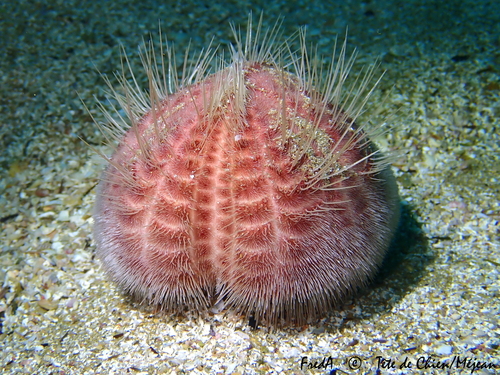
About Spatangus purpureus O.F.Müller, 1776
Spatangus purpureus has a somewhat flattened test, with a flat oral (underside) surface and a domed aboral (upper side) surface. It is an irregular sea urchin that is not radially symmetric like most other sea urchins. It has a notch at its front, a forward-pointing mouth, and an anus at the rear. It grows up to 12 cm (5 in) in length and 8 cm (3 in) in width. Its test is reddish-purple, and it has two types of spines: many short, silky, purplish spines reaching up to 1 cm (0.4 in) long, and fewer, 3 to 4 cm (1.2 to 1.6 in) long beige chitinous spines. Spatangus purpureus is native to the eastern Atlantic Ocean, the Mediterranean Sea, and the English Channel. Its range extends from Iceland and Norway's North Cape southward to Senegal. It lives buried in coarse sand or gravel, and is rarely found in mud. It occurs from shallow wave-sheltered sub-littoral areas down to a depth of approximately 900 m (3,000 ft). While the natural diet of Spatangus purpureus was originally unknown, it is commonly found in beds of soft red algae. Analysis of its gonads identified two polyunsaturated fatty acids also found in red algae, plus palmitoleic acid found in sediment, with the ratio of these compounds matching the relative abundance of these two food sources. This evidence indicates that Spatangus purpureus has omnivorous feeding habits, with phytodetritus from algal beds making up an important part of its diet. This sea urchin often hosts other associated organisms: a small bivalve mollusc, Montacuta substriata, attaches to its spines, and the polychaete worm Malmgreniella castanea, which grows 1 or 2 cm (0.4 or 0.8 in) long and has large purple scales, lives among its spines. The main predator of this species is the red comb star Astropecten aranciacus. Sea breams can crush its test to eat its soft internal contents. In the Mediterranean Sea, the helmet shell Galeodea echinophora drills a hole through the test, inserts its proboscis, and digests the soft tissues inside.

