About Sparidae
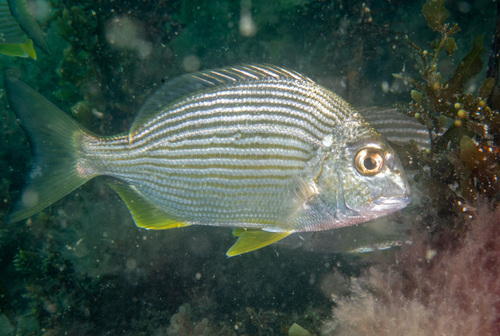
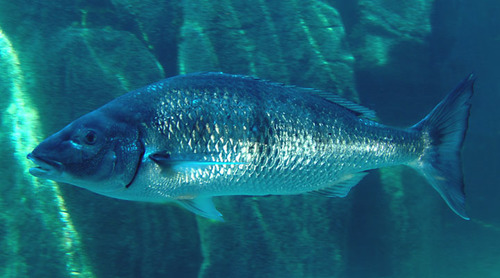
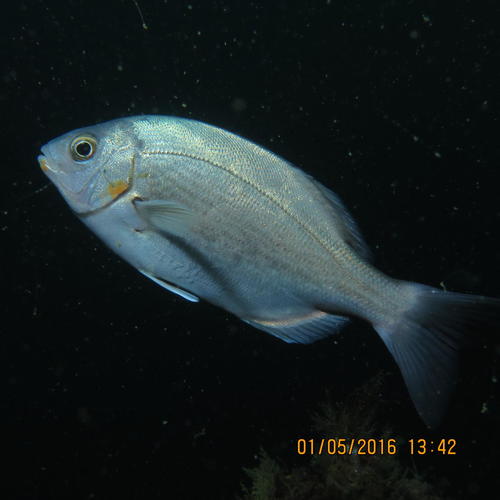
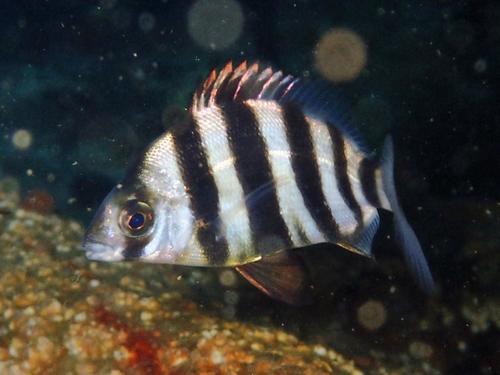
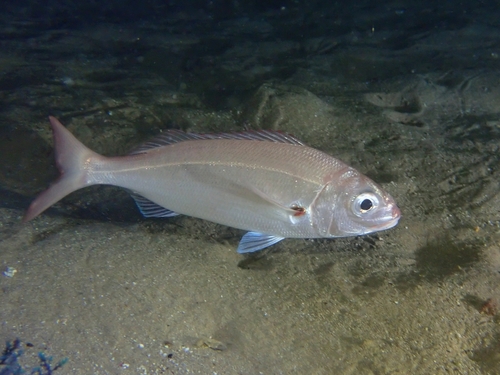
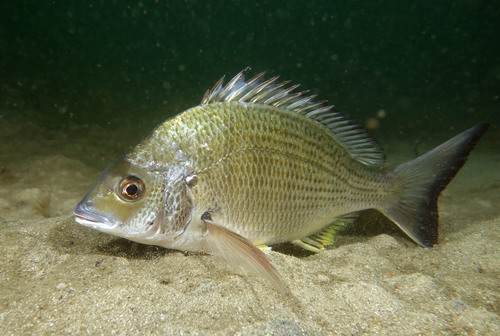
Members of the Sparidae family, commonly called breams, have oblong, moderately deep, compressed bodies. They have large heads with a characteristic steep dorsal slope. Scales are absent from the snout but present on the cheeks. The preoperculum may or may not have scales, and its margin has no spines or serrations. The scaled operculum also has no spines. Their mouth is slightly oblique, can protrude slightly, and the upper jaw never extends backward past a vertical line running through the center of the eye. Jaws hold teeth that vary in shape from conical to flattened, but there are no teeth on the roof of the mouth. Sparids have a single dorsal fin supported by 10 to 13 spines and 9 to 17 soft rays; the ultimate ray is split into two, and there is no incision separating the spines from the soft rays. The rearmost spines of the dorsal fin may be elongated or filamentous. The anal fin is supported by 3 robust spines and 7 to 15 soft rays. The caudal fin ranges from moderately deeply emarginate to forked. Pectoral fins are typically long and pointed, while pelvic fins sit under or immediately behind the bases of the pectoral fins. Pelvic fins are supported by a single spine and 5 soft rays, and have a scale in the axilla called the axillary pelvic process. Scales are typically either smooth cycloid scales or weakly ctenoid scales that feel slightly rough to the touch. The lateral line is single and continuous, extending all the way to the base of the caudal fin. Sparids show high variation in coloration, ranging from pinkish or reddish to yellowish or greyish, and often have silver or gold tints alongside dark or colored spots, stripes, or bars. The two largest sparid species are the white steenbras (Lithognathus lithognathus) and the red steenbras (Petrus rupestris), both with a maximum published total length of 200 cm (79 in). The smallest recognized species is the cherry seabream (Polysteganus cerasinus). Sparid breams occur in tropical and temperate coastal waters worldwide. They are demersal fish that live on the continental shelf and continental slope. A small number of species live in brackish water, and some of these species will enter fresh water. For culinary use, the most highly regarded breams are the gilt-head bream and the common dentex.