About Sparganium americanum Nutt.
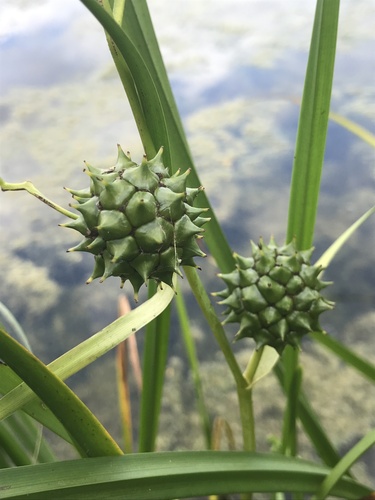
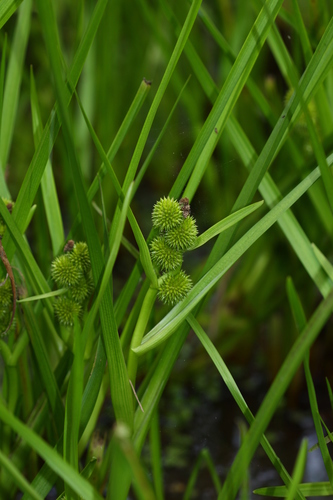
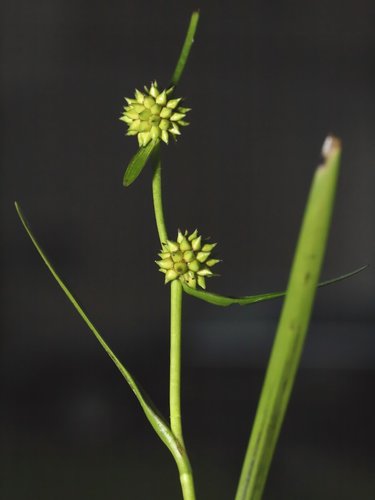
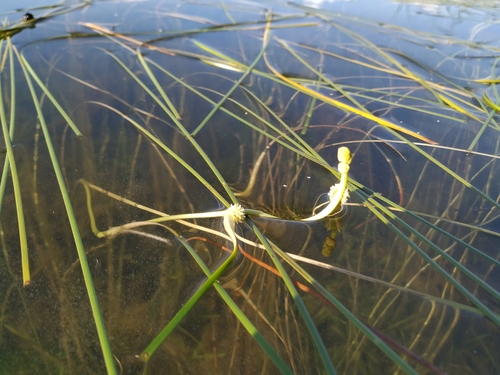
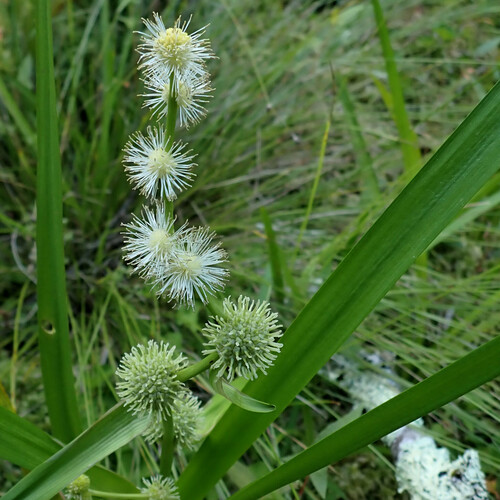
Sparganium americanum Nutt., commonly called American bur-reed, is a monocot perennial plant. While individuals of this species may resemble grass, they are not actually grass. American bur-reed plants grow to heights between 2 and 4 feet. Their leaves are green with a triangular cross-section; plants growing in deeper water may produce floating leaves. American bur-reed grows from spring to fall in low marshes and shallow water that is 0 to 12 inches deep, and it can survive in water up to 12 inches deep. It is distributed across the United States and Canada. In the United States, it occurs in Alabama, Arkansas, Connecticut, Washington DC, Delaware, Florida, Georgia, Iowa, Illinois, Indiana, Kansas, Kentucky, Louisiana, Massachusetts, Maryland, Maine, Michigan, Missouri, Mississippi, North Carolina, North Dakota, New Jersey, New York, Ohio, Oklahoma, Pennsylvania, Rhode Island, South Carolina, Tennessee, Texas, Virginia, Vermont, Wisconsin, and West Virginia. In Canada, it occurs in Manitoba, New Brunswick, Newfoundland, Nova Scotia, Ontario, Prince Edward, and Quebec. It grows in peaty to sandy soils along lakeshores and slow-moving streams, and can also be found as floating vegetation in boggy lakes. This species helps to stabilize muddy areas. Waterfowl and other animals feed on its seeds, and some animals also eat its leaves; specifically, waterfowl and marsh birds eat the seeds, and muskrats eat the entire plant. A study conducted by scientists from the State University of New York at Binghamton compared S. americanum to four other wetland plant species: Phalaris arundinacea, Scirpus cyperinus, Juncus effusus, and Calamagrostis canadensis. The study found that S. americanum accumulated more aboveground biomass and less belowground biomass than the four other species. It also had the highest concentration of nitrogen and phosphorus in aboveground tissue out of all the species included in the study. Despite accumulating the most aboveground nitrogen and phosphorus, S. americanum lost so much phosphorus that its net nutrient retention was lower than that of the other study species. In the short term, American bur-reed is useful for retaining nutrients from agricultural runoff.