About Spalax ehrenbergi Nehring, 1898
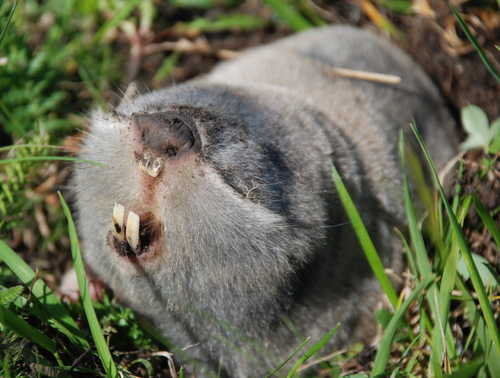
The Middle East blind mole-rat, whose scientific name is Spalax ehrenbergi Nehring, 1898, weighs 100–200 grams (3.5–7.1 oz). It has light gray fur and four sharp teeth: two large teeth in the upper jaw and two smaller teeth in the lower jaw. It can live up to 20 years, and is notable for its adaptability to severe lack of oxygen. In Israel, this blind mole-rat is a major agricultural pest. It digs long tunnels up to 80 centimeters deep, and stores onions and tubers in underground chambers. The exceptional ecological adaptation strategies of blind mole-rats can be seen in variation in their tongue morphologies, as evidenced by their tongue papillae. Tongue papillae differ between individuals within the species to adapt to different environmental regions with varying soil characteristics and food types. Spalax ehrenbergi is found in Libya, Egypt, Iraq, Turkey and the Levant (Israel, Syria, Palestine, Jordan and Lebanon). Its natural habitat is Mediterranean-type shrubby vegetation, and it is threatened by habitat loss. According to Israeli researchers at Haifa University, the Middle East blind mole-rat is an important laboratory animal for cancer research, due to its apparent resistance to the disease. Data on S. ehrenbergi cancer resistance was documented in a 2013 study: no spontaneous tumors have ever been observed in blind mole-rats, based on observations of thousands of individuals over half a century. When cancer was induced with chemical carcinogens that produced 100% of expected tumors in mice and rats after 2–6 months respectively, Spalax showed extraordinary cancer resistance: only 2 out of 12 animals, both older than 10 years, developed the expected tumor from one of the carcinogens, and only after 18 and 30 months. Nannospalax fibroblasts (cells), and only Nannospalax cells, kill cancer cells from different species (including a wide range of human cancer cells) when grown in co-culture. This effect also occurs when cancer cells are grown in medium that previously held Nannospalax cells. Identifying the substances secreted by Nannospalax fibroblasts and the membrane component on cancer cells they interact with, which leads to cancer cell death, could open a path to finding a general cure for cancer. Cancer resistance has also been noted in N. judaei and N. golani, two former species that are currently merged into S. ehrenbergi. The genome of N. galili was sequenced in 2014. Studies on in vitro fibroblast growth in N. judaei and N. golani showed that the process of necrosis replaces the role of the systematic apoptosis normally used in most organisms. Generally, low-oxygen conditions, such as those common in blind mole rats' burrows, usually cause cells to undergo apoptosis. One study found that, as an adaptation to a higher tendency of cell death, blind mole rats evolved a mutation in the tumor suppressor protein p53 (which is also used in humans) to prevent cells from undergoing apoptosis. Human cancer patients have similar mutations, and blind mole rats were thought to be more susceptible to cancer because their cells cannot undergo apoptosis. However, after a specific amount of time (within 3 days, according to one study), blind mole rat cells release interferon-beta (a substance the immune system normally uses to counter viruses) in response to over-proliferation of cells caused by apoptosis suppression. In this mechanism, interferon-beta triggers cells to undergo necrosis, and this process also kills cancer cells in blind mole rats. Tumor suppression mechanisms like this are what make blind mole rats and other spalacids resistant to cancer. The involvement of interferon in the so-called concerted cell death of Spalax cells via necrosis has been highly disputed, and serious questions have been raised about inconsistent methodology that led to this original claim. Observing dirt displaced by burrowing mole rats can help archaeologists decide where to dig, since displaced dirt often contains small artifacts like potsherds.