About Spalacopus cyanus (Molina, 1782)
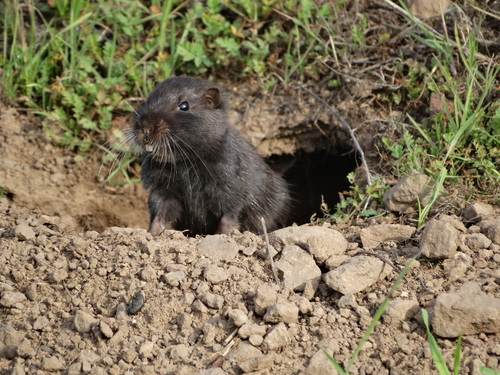
Coruros (Spalacopus cyanus) are robust, stocky rodents with large heads, short necks, small eyes and ears, and short tails. Their fur is short, and individuals can be black or dark brown, with fur turning blackish on the feet. Their tails are scaly, hairless, and smooth. This species is heavily adapted for underground life. They have large forward-curving incisors used to loosen soil and gnaw through roots, strong forelimbs for digging, and powerful hind limbs to move soil and kick it out of burrow entrances. Adults weigh between 82 and 118 grams (0.18 to 0.26 lb). The molars of coruros have reentrant folds that do not meet in the middle. Coruros are distributed along the coast and in the Andes from Alicahue (32°19'S) to Los Cipreses (34°01'S), occurring at altitudes up to 3500 m in the Andes. They inhabit a variety of habitats, including mountain alpine grasslands, acacia savannah in Chile's Central Valley, semi-stabilized sand dunes, and coastal grassland. Coruros are colonial rodents, with multiple individuals sharing a single burrow system. Unlike most rodents, they are nomadic: when food supplies run out in an area, the whole group moves to a new location to dig a new burrow system. Colonies form when smaller groups split off from larger original populations. Coruros leave bulbs unused to allow them to regrow, so the group can return to the area to feed on new vegetation later. This is a vocal species that produces a range of distinct calls. Their predators include hawks, owls, and wild cats. Breeding occurs from June to March. Females can produce up to six offspring per litter. The gestation period lasts approximately 77 days, and newborns' eyes open around four days after birth. Coruros feed entirely underground, eating grasses, herbs, roots, and bulbs of geophytes. Leucocoryne ixioides makes up the bulk of their diet; they also consume bulbs from Dioscorea longipes, and species from the genera Libertia, Sisyrinchium, and Alophia, as well as huilli and other vegetation. This species is not currently considered endangered.