About Sorex ornatus Merriam, 1895
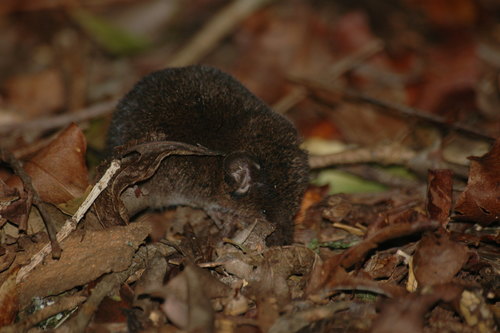
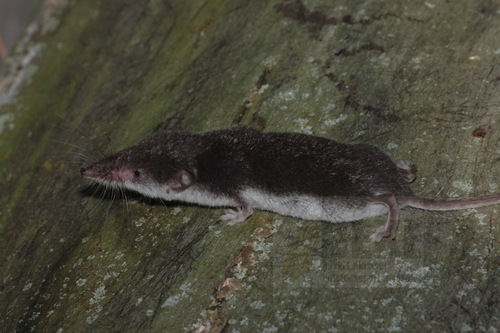
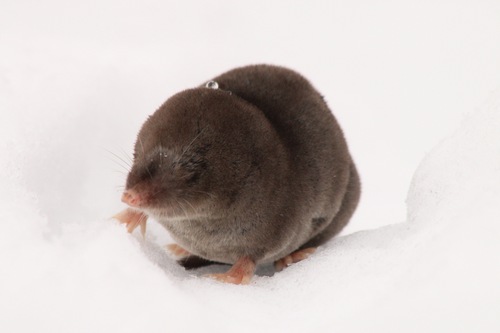
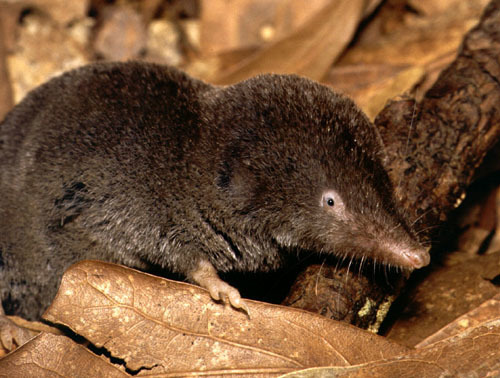
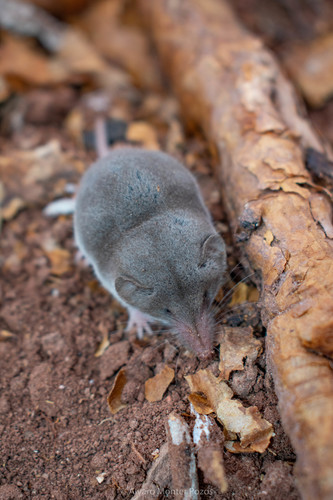
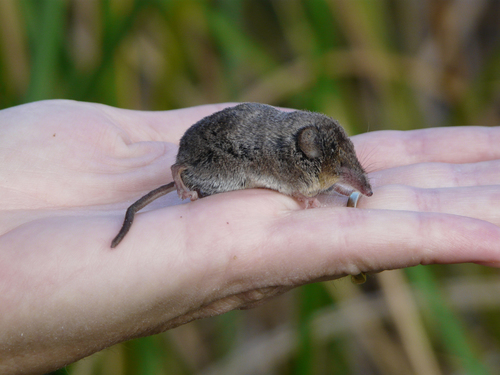
The ornate shrew (Sorex ornatus Merriam, 1895) is a small mammal, with an average weight of 5.12 g (0.181 oz), an average total length of 99.4 mm (3.91 in), an average hind foot length of 12.1 mm (0.48 in), and a relatively short average tail length of 37.5 mm (1.48 in). This shrew molts, and its fur coloring changes throughout the year. Its overall coat is drab: it is brown on the back, fading to gray or buff on the underside. In winter, the back is darker brown, and the underside tends toward grayish-white. Southern subspecies are generally larger and have darker markings than northern subspecies. Because coat pattern varies so widely among individuals, fur characteristics are not a reliable way to identify ornate shrew subspecies. Scientists rely instead on gene sequencing and tooth morphology for more accurate identification. On average, the ornate shrew's skull is 16.3 mm (0.64 in) long. Its palate averages 6.82 mm (0.269 in) in length, and the average distance between its eye sockets is 3.31 mm (0.130 in). Its cranium is around 4.59 mm (0.181 in) long and 7.96 mm (0.313 in) wide. The skull is overall quite flat and broad, with a depression between the eye sockets. Among all vertebrates, shrews have the largest brain-to-body weight ratio. The ornate shrew's tail is bicolored, fading gradually from brown on the upper side to gray on the underside. The reported dental formula for Sorex ornatus is: 3.1.3.3 / 1.1.1.3 × 2 = 32 total teeth.
The ornate shrew occurs along parts of the west coast of North America, and on a small number of nearshore islands. Its range reaches as far north as around 39 degrees latitude in California, then extends south into the Baja California peninsula. There is an unoccupied stretch of territory through central Baja California, and the species occurs again near the southern tip of the peninsula. A subspecies (S. o. willetti) lives on Santa Catalina Island, and populations have also been recorded on Santa Cruz and Santa Rosa islands. Ornate shrews live in coastal marshes and palustrine environments, and prefer dense vegetation located near water. Capture sites for the species are consistently more moist than dry, so the loss of wetland habitats reduces available range for the shrew. Some subspecies are restricted to specific unique habitats. The species has been recorded at altitudes as high as 2,400 metres (7,900 ft) in the San Jacinto Mountains. Ornate shrews were once common and widespread across their full range, but populations in sensitive ecological areas (including coastal wetlands, salt marshes, and freshwater swamps) have declined sharply. The species is also less common or extirpated from areas of intensive agriculture in central California.
The ornate shrew's breeding season runs from late February to late September or October. While similar-sized shrews have a gestation period of around 21 days, no confirmed gestation data exists for this species. Litters contain 4 to 6 young, and the average lifespan of ornate shrews is roughly 12 months. The species does not hibernate, though some shrew species enter a state of inactivity during harsh conditions like extreme cold. The ornate shrew's small size gives it a fast metabolic rate and causes it to lose heat quickly, which means it often struggles to maintain its body temperature, especially in colder environments. Its short lifespan leads to a high annual population turnover rate. Ornate shrews need to eat at least 24 insects per day, particularly in colder seasons when much of their energy is used to stay warm. The species relies on dense vegetation for shelter from predators and for nesting sites. Habitat destruction is the main threat to ornate shrew populations, as much of their wetland habitat has been affected by invasive plants and human conversion for agricultural use. Ornate shrews are active both day and night, but are mostly nocturnal during the breeding season from spring to late summer. Ornate shrews are generally not aggressive toward one another except under stressful conditions: studies show mature shrews become antagonistic when food and water supplies are scarce. Observations of behavioral interactions between males and females show that this species has a female-dominated social structure.