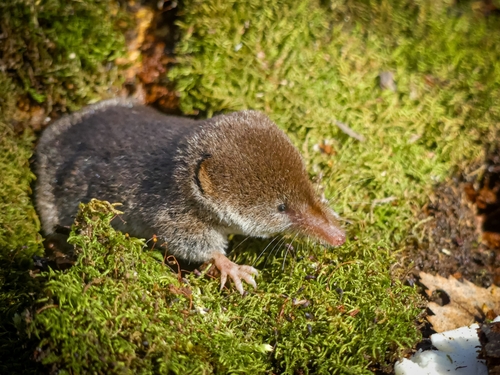
About Sorex fumeus G.M.Miller, 1895
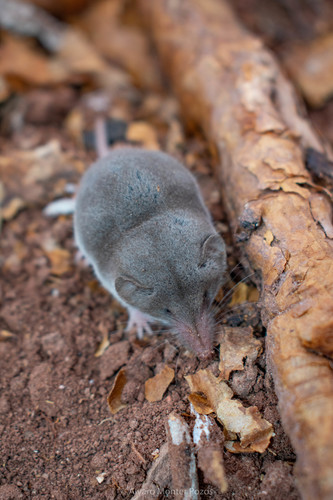
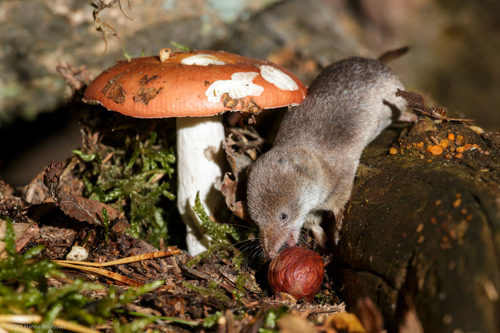
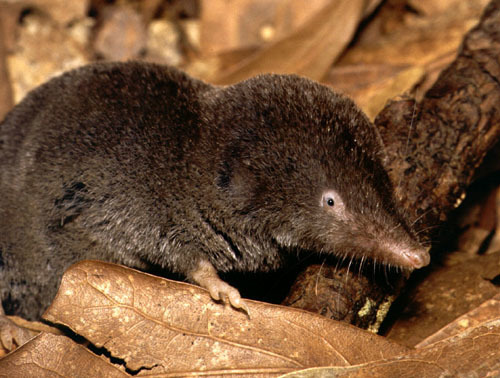
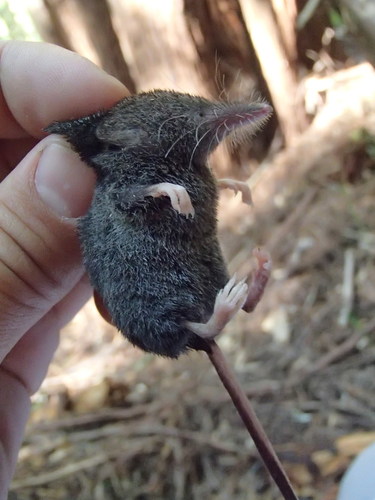
Sorex fumeus G.M.Miller, 1895, commonly called the smoky shrew, is active year-round. It has a dull grey color, with lighter fur on its underparts. It has a long tail that is brown on top and yellowish underneath; its fur stays grey through the winter. The full body length of an adult is roughly 11 centimeters (4.3 inches), which includes a 4 centimeter (1.6 inch) long tail, and adults weigh about 5 grams (0.18 oz).
This species lives near streams in cool, damp deciduous and mixed woodlands. It makes extensive, solitary burrows in the leaf litter of the forest floor, or builds globular nests 10–15 centimeters (3.9–5.9 inches) in size out of plant materials under rocks. The smoky shrew rarely digs its own tunnels, instead it uses tunnels already created by moles or other shrews. Its diet is mainly made up of beetles, but it also eats a variety of other prey including various insects, earthworms, small rodents, snails, and other soil-dwelling invertebrates. It supplements its diet with small amounts of plant material. Known predators of the smoky shrew include owls, snakes, foxes, weasels, and mustelids.
Mating for smoky shrews begins in late March. After a gestation period of around 20 days, females give birth to their first litters in April or May. Females can mate again immediately after the first litter is born. If a female survives long enough, she may have two more litters after the first, with each litter born roughly one month apart. Each litter contains between two and eight pups, with an average of six pups per litter. After one month of growth, offspring weigh around 4 grams, which is half of an adult's body weight. Males do not participate in caring for offspring; only females provide parental care. Females build nests in leaf litter where they give birth. At birth, pups are blind, helpless, and lack fur. Females nurse and protect their offspring for a short period, less than 20 days total.