About Sorex cinereus Kerr, 1792
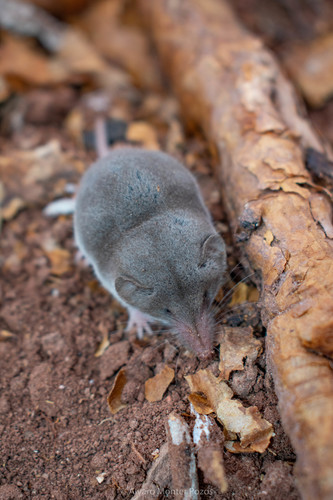
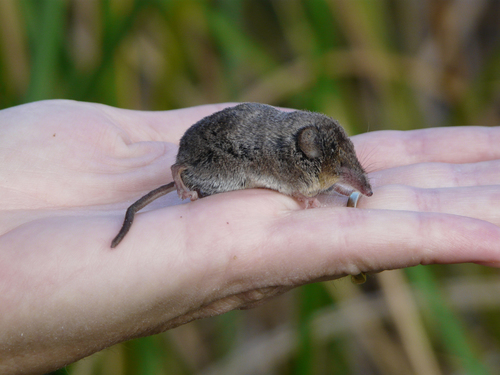
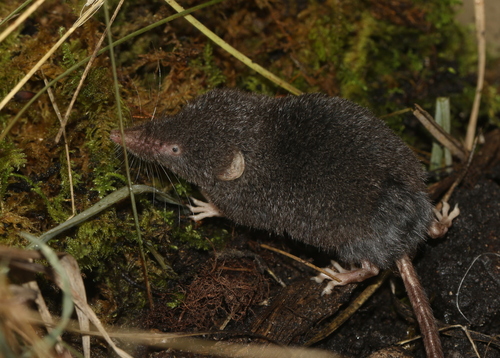
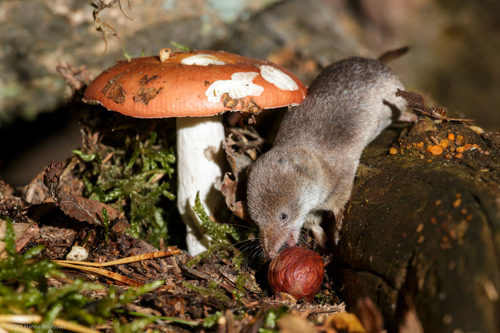
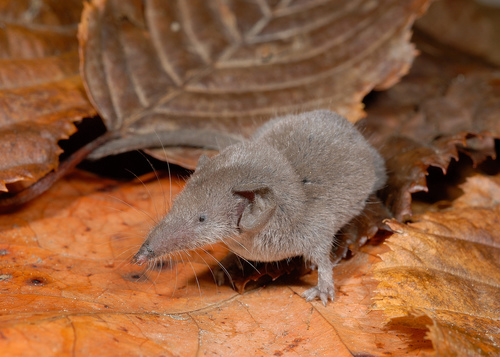
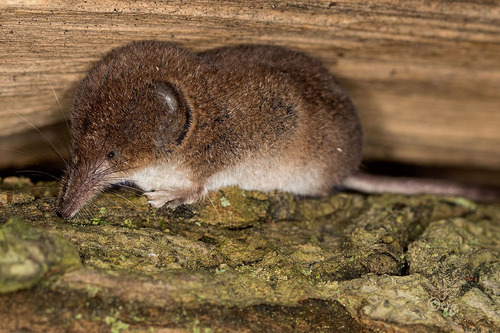
Sorex cinereus, commonly called the masked shrew, is grey-brown with a light grey underside and a pointed snout. It has a long tail that is brown on top, pale underneath, and marked with a dark tip. Its total body length is about 9 cm (3.5 in), which includes a 4 cm (1.6 in) tail, and it weighs approximately 5 g (0.18 oz). This species has darker colouring than other shrews. Masked shrews can live up to two years, with an average survival of eighteen months. A long-term 2005 study of 650 masked shrew specimens collected in Alaska between 1950 and 2003, conducted by Yom-Tov and colleagues, found that the species' body size pattern contradicts Bergmann's rule. The study examined the relationship between masked shrew body size and ambient temperature, taking measurements of body weight, and body, tail, ear, and hind foot length. Results showed that masked shrew body size decreases at high latitudes and in areas with lower mean January temperatures, a trend that opposes the pattern described by Bergmann's Rule. Researchers suggested this may be a coping mechanism to limit total energy requirements, due to reduced food availability during winter months. The study also found that body and tail length increased as temperatures rose during the second half of the twentieth century, a change that may be linked to higher temperatures increasing the availability of the shrew's main diet. The masked shrew is the most widely distributed shrew species. Its range covers most of northern North America, extending south to Maryland in the east, along the Rocky Mountains in the west, and to the Appalachian Mountains. This species was introduced to Newfoundland in the late 1950s. It can occupy a wide variety of habitat types, including arid grasslands, moist areas, woodland, and tundra. Masked shrews mostly live in humid areas with dense vegetation that provides cover. Moisture levels are the main factor that determines the local abundance of this shrew. For masked shrews living at high latitudes, individuals are born in late spring or summer, reach adult size before leaving their nests, and complete their entire life cycle within one year. Individuals born in spring or summer remain immature over winter, and breed for the first time the following spring. Across populations, masked shrews breed from May to September. Females produce one litter of 6 to 7 young each breeding season. Newborn masked shrews are hairless, lack claws, and have translucent abdominal walls. Young shrews' body mass increases to a peak at twenty days old, then decreases before the young leave the nest at around 27 days old. Masked shrews have a high mortality rate during their first two months of life, and most individuals die within their first year. They become sexually mature at two months old, but delay breeding until their first spring.