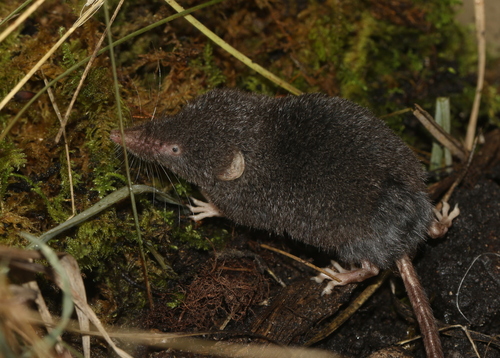
About Sorex alpinus Schinz, 1837
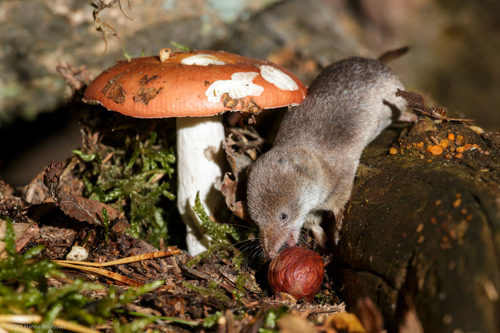
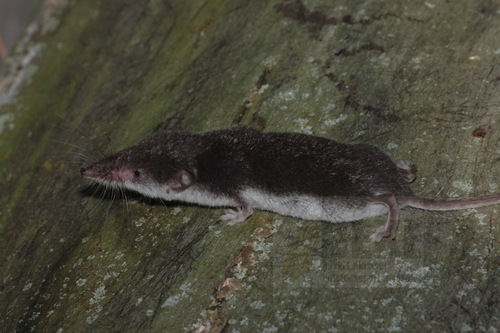
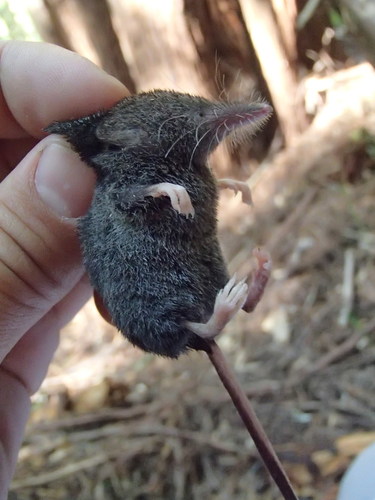
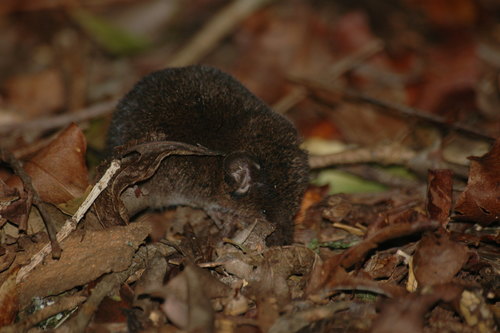
The Alpine shrew (Sorex alpinus Schinz, 1837) has a body length of 6 to 7.7 centimetres (2.4 to 3.0 in), not counting a tail that is as long as its body. Its weight ranges between 5.5 and 11.5 g (0.2 to 0.4 oz). Its dorsal (upper) surface is a uniform greyish-black, and its underparts are greyish-brown. The tips of its teeth are reddish-brown; it also has a long pointed snout, small black eyes, and rounded pink ears. Its legs and feet are white, and the underside of its hairy tail is yellowish. Juveniles are somewhat paler than adults. It shares its range with the common shrew Sorex araneus and the Eurasian pygmy shrew Sorex minutus, but can be distinguished from these two species by its darker fur and longer tail. The Alpine shrew is found in the mountains and uplands of Central and Eastern Europe, and in parts of France. Specific locations within its range include the Alps, the Black Forest, the Jura Mountains, the mountains of southern Germany, the Giant Mountains, the Beskids, the Tatra Mountains, the Carpathian Mountains, the Transylvanian Alps, the uplands of Vosges, and the mountains of the former Yugoslavia. This species inhabits Alpine meadows and coniferous woodland at elevations between approximately 200 and 2,500 metres (660 and 8,200 ft). It sometimes occurs above the tree line, but more typically prefers damp pastures and swampy ground near small streams in areas with sparse dwarf conifers near the upper limit of tree cover. It tends to hide in dense vegetation, occupy rock crevices, and live under boulders or fallen branches, and is often found near mountain huts. The Alpine shrew was recorded in the Spanish Pyrenees in the early 20th century, and is presumed to be locally extinct there due to the absence of modern sightings.