About Sorbus americana Marshall
Sorbus americana, commonly known as American mountain-ash, is a relatively small tree that reaches up to 12 metres (40 ft) in height. Its largest known specimens grow on the northern shores of Lake Huron and Lake Superior, and it resembles the European mountain-ash, Sorbus aucuparia.
Its bark is light gray and smooth, with a scaly surface. Young branchlets are initially downy, and later become smooth, brown with a red tinge, and marked with lenticels; mature branchlets darken, and their papery outer layer becomes easily separable. The wood is pale brown, light, soft, and close-grained but weak. It has a specific gravity of 0.5451, and weighs 33.97 lbs per cubic foot.
The winter buds are dark red and acute, measuring one-fourth to three-quarters of an inch long. Their inner scales are very tomentose (covered in dense, soft hairs) and enlarge as the shoot grows.
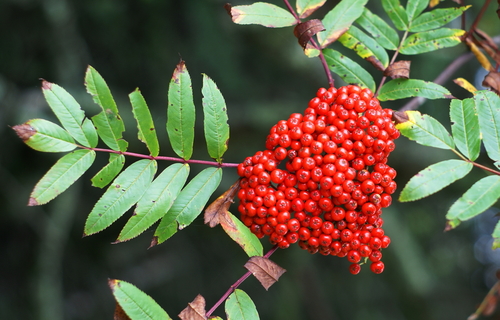
The leaves are alternate, compound, and odd-pinnate, growing 6 to 10 inches (15 to 25 cm) long, with a slender, grooved petiole that is dark green or red. There are 13 to 17 leaflets, which are lanceolate or long oval, two to three inches long and one-half to two-thirds of an inch broad, with an unequally wedge-shaped or rounded base, serrated edges, and an acuminate tip. The leaflets are sessile (lacking a stalk), except the terminal leaflet which sometimes grows on a stalk half an inch long. They are feather-veined, with a prominent midrib beneath and a grooved midrib above. When emerging from the bud, leaflets are downy and folded; when fully grown, they are smooth, dark yellow green above and paler beneath. In autumn, the leaves turn a clear yellow. The leaf-like stipules are caducous (fall off early).
Flowers bloom in May to June, after leaves are fully grown. The flowers are perfect (bisexual), white, one-eighth of an inch across, and borne in flat compound cymes that measure three or four inches across. The small, acute bracts and bracteoles are caducous. The calyx is urn-shaped, hairy, and five-lobed; the short, acute lobes overlap (imbricate) in bud. The corolla has five creamy white, orbicular petals that narrow into short claws, are inserted on the calyx, and are imbricate in bud. There are 20 to 30 stamens inserted on the calyx tube, with thread-like filaments; the anthers are introrse, two-celled, and open longitudinally. The pistil consists of two to three carpels inserted at the bottom of the calyx tube and united into an inferior ovary, with two to three styles and capitate stigmas; each ovary cell holds two ovules.
The fruit is a berry-like pome, globular, one-quarter of an inch across, bright red, and borne in cymous clusters. It ripens in October and remains on the tree throughout the winter. The flesh is thin and sour, contains malic acid; the seeds are light brown, oblong, and compressed, with fleshy cotyledons.
This species is native to eastern North America, with a distribution that includes Eastern Canada (New Brunswick, Newfoundland, Nova Scotia, Ontario, Prince Edward Island, Quebec), the Northeastern United States (Connecticut, Maine, Massachusetts, New Hampshire, New Jersey, New York, Pennsylvania, Vermont), the North-Central United States (northern Illinois, Ogle County; Michigan, Minnesota, Wisconsin), and the Southeastern United States (Appalachian Mountains, Georgia, Maryland, North Carolina, Tennessee, Virginia, West Virginia). It is listed as endangered by the state of Illinois.
Sorbus americana is cultivated as an ornamental tree for gardens and parks. It prefers rich, moist soil and swamp borders, but will also grow well on rocky hillsides. One cultivar is Sorbus americana 'Dwarfcrown', also called red cascade mountain-ash, which is planted in gardens and as a street tree.
After the first winter freeze, the fruits are edible raw or cooked, and can be used to make pie and jelly.