About Sophora flavescens Aiton
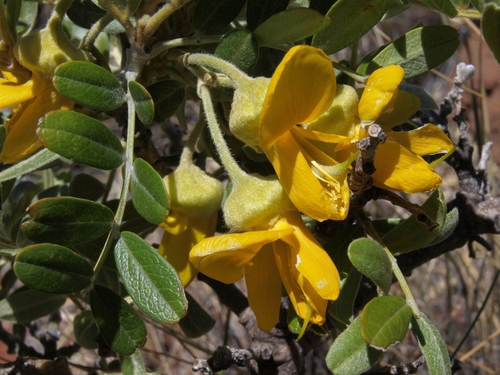
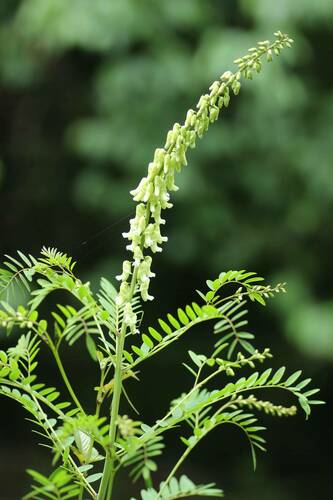
Sophora flavescens Aiton is a plant that can reach a height of 2 meters. When young, its stem has visible stripes and is covered in soft hairs. Its leaves are typically 20 to 25 centimeters long, with lanceolate stipules and 13 to 25 leaflets that are elliptic, ovate, or lanceolate in shape. The plant produces terminal racemes that are 15 to 25 centimeters long, which hold many widely spaced flowers. Each flower has a slender pedicel and a linear bract, and its spoon-shaped petals can be white, pale yellow, purple-red, or red. This species blooms from June to August, and produces fruit from July to October.
Sophora flavescens is native to China, where it occurs in every province. It can also be found in India, Japan, Korea, and the Russian Far East. It grows primarily on mountain slopes, sloped sandy grasslands, shrub forests, and around fields, most commonly at elevations below 1500 meters.
Use of the plant's root may cause toxic effects including nausea, dizziness, vomiting, constipation, muscle spasms, impaired speech, irregular breathing, respiratory failure, and death.
Sophora flavescens is an evergreen, slow-growing shrub that typically grows to 1.5 meters (4.9 feet) tall and 1 meter (3.3 feet) wide. It is hardy to temperatures between 0 and 10 °F (−18 to −12 °C), which corresponds to USDA hardiness zone 6. It grows in light (sandy), medium (loamy), and heavy (clay) well-drained soils, and tolerates acid, neutral, and basic (alkaline) soil pH. It cannot grow in shade, and requires moist soil. Like many other species in the legume family Fabaceae, Sophora flavescens can fix atmospheric nitrogen.