About Solorina crocea (L.) Ach.
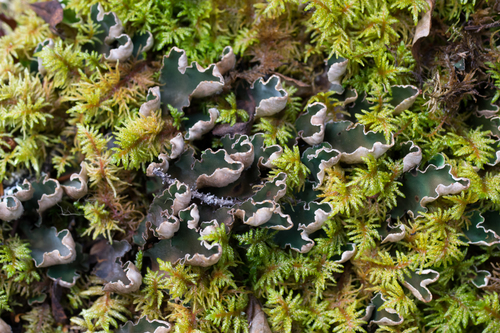
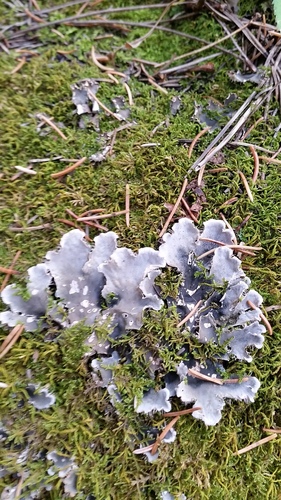
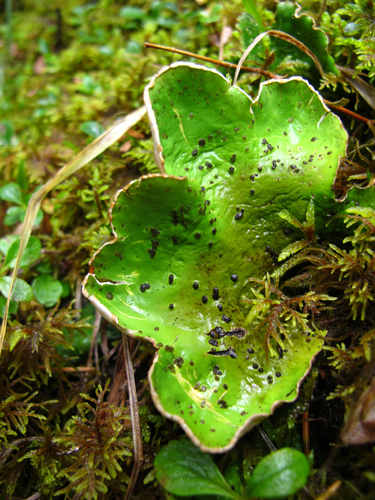
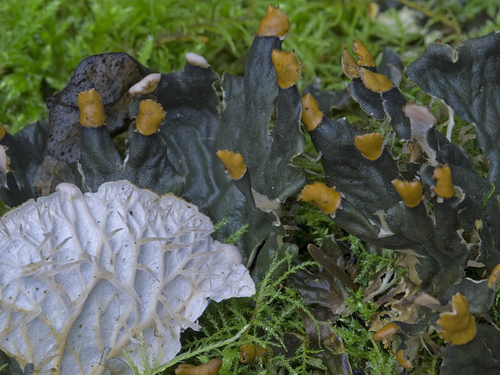
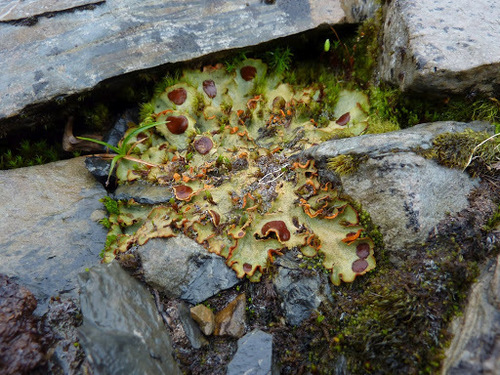
Solorina crocea (L.) Ach. has a foliose thallus that forms large rosettes made up of thick, rounded lobes. It typically grows up to 6 cm (2+3⁄8 in) across, though specimens up to 10 cm (4 in) wide have been recorded. It is usually tightly pressed against the surface it grows on. The lobes that make up the thallus are 5–15 mm (3⁄16–9⁄16 in) wide, with slightly upturned edges, and their outline ranges from irregular to rounded. When moist, the upper surface of the thallus is olive green; it changes to reddish brown when less hydrated. The lower thallus surface is bright orange, with a tomentose texture and a somewhat reticulate pattern of brownish veins. It lacks a cortex (an outer layer of compacted hyphae), and looks like a mat of orange, entangled threads. The medulla is orange. Isidia and soredia are absent. The distinctive colour difference between the upper and lower surfaces makes this lichen easy to identify, though this difference can be hard to see in the field when the lichen is tightly attached to its substrate. The apothecia are brown to reddish-brown, measure 2–10 mm (1⁄16–3⁄8 in) in diameter, and sit either roughly level with the cortex or are slightly convex, rather than positioned in concave depressions like they are in some other Solorina species. The photobiont partners of Solorina crocea are arranged in two distinct layers within the thallus: a roughly continuous layer of green algae sits above a patchy cyanobacterial layer. Each ascus of Solorina crocea contains six to eight ascospores. The spores are brown, ellipsoid in shape, and have a single transverse septum that splits the spore into two compartments. Measurements of sampled European specimens give an average ascospore size of 11.0 μm wide (ranging from 8.4 to 21.2 μm) by 39.0 μm long (ranging from 26.6 to 51.1 μm). Scanning electron microscopy study of fine ascospore structure has shown that each common arctic-alpine Solorina species has consistent, distinctive spore ornamentation. In S. crocea, spores are covered in irregularly shaped papillae (small pimple-like structures), and do not form ridges or reticulations. The spore tips are rounded, and there is a slight constriction between the two spore cells. Solorina octospora shares similar spore size and ornamentation with S. crocea, but it does not contain solorinic acid and does not have an orange-coloured medulla. In terms of habitat and distribution: In North America, its range stretches from polar alpine to subalpine habitats, south to California and New Mexico. European countries where the lichen has been recorded include Andorra, Austria, Bulgaria, Spain, Iceland, and Finland. In the UK, it grows in the Scottish Highlands, and there is only a single recorded occurrence in Ireland. Its distribution in Italy is restricted to the high-altitude Alps and the northern Apennines. In India, it is found in Himalayan regions: Himachal Pradesh and Sikkim. Its range extends to the Eastern Himalayas, and it has been recorded in Xizang, Tibet, at an altitude of 4,820 m (15,810 ft). In New Zealand, it has been collected from Mount Peel at 1,350 m (4,430 ft) altitude. Habitats where it has been recorded include boulder fields, leached windswept ridges, and solifluction areas. In Iceland, Solorina crocea grows in Salix herbacea snowbeds and on north-facing slopes with abundant grasses and sedges. Generally, the lichen grows on bare ground in sandy soil, and can grow in both acid-rich and base-rich soils that form from seepage from late-lying snow patches.