About Solidago spectabilis (D.C.Eaton) A.Gray
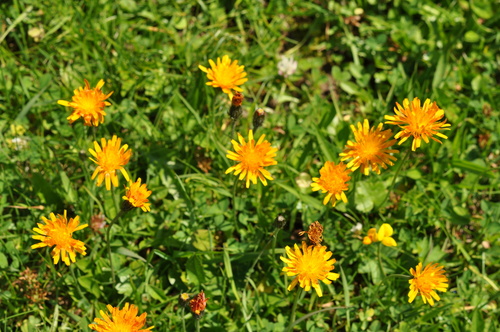
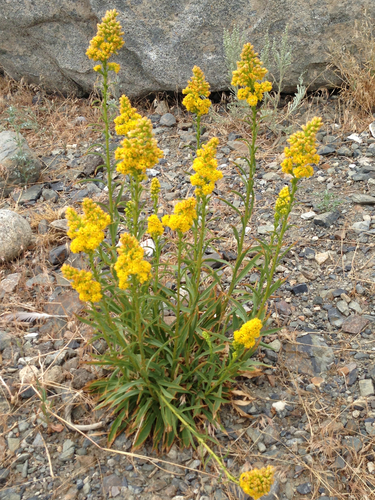
Solidago spectabilis, commonly called Nevada goldenrod, basin goldenrod, and showy goldenrod, is a goldenrod species native to the western United States. It occurs in the Great Basin and surrounding regions, with confirmed populations in California, Arizona, Nevada, Oregon, and Utah. Historical records document that this species once grew in southwestern Idaho, but it is now extirpated from that area. It has also been observed in Sanders County, western Montana. This goldenrod grows in a variety of moist habitats, including bogs, meadows, seeps, streambanks, hot springs, and wet areas on alkali flats. It is a rhizomatous perennial herb that produces one or more upright stems, which can reach a maximum height of two meters (5 feet). The plant is mostly hairless, though it may occasionally have patches of rough hairs. It forms a basal rosette of fleshy, lance-shaped leaves that can measure up to 25 centimeters (10 inches) long; these leaf blades grow from winged petioles. The edges of the basal leaves may be wavy or slightly toothed. Leaves positioned higher on the stem are smaller and usually have smooth edges. Its inflorescence is a large, upright or arching cluster holding many flower heads, and some inflorescences can contain up to 100 flower heads. Each flower head holds 8 to 22 yellow disc florets, surrounded by 5 to 15 narrow yellow ray florets that are no longer than 4 millimeters each.