About Solidago discoidea (Elliott) Torr. & A.Gray
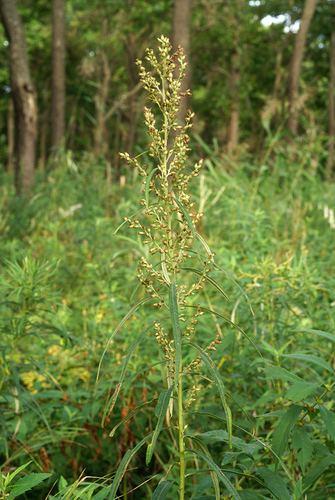
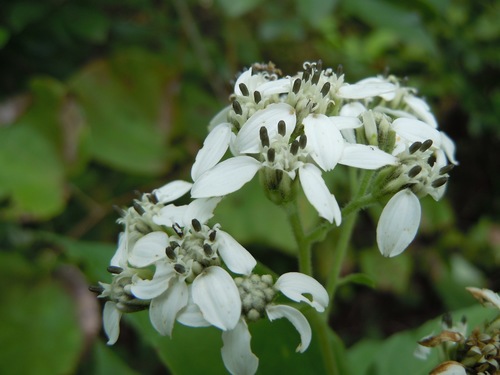
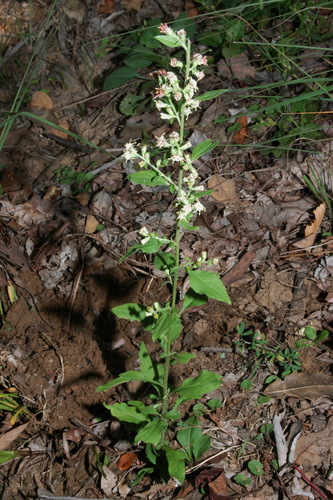
Brintonia is a monotypic genus of flowering plants in the sunflower family, which holds only one species: Brintonia discoidea. This species was named for Jeremiah Bernard Brinton, and is commonly known as rayless mock goldenrod. Its currently accepted scientific name under Solidago is Solidago discoidea (Elliott) Torr. & A.Gray. It is native to the southeastern United States, distributed across Alabama, Florida, Georgia, Louisiana, and Mississippi. This plant is a perennial herb that grows up to 1.5 meters tall from a thick rhizome. It has an erect, unbranched stem covered in light hair. Its alternately arranged leaves have rough-haired serrated blades that reach up to 10 centimeters long, growing on winged petioles. The inflorescence is a wide array made up of several flower heads. Each flower head contains up to 20 disc florets, which have bright green tubes, whitish or pinkish corollas, and pinkish anthers. The fruit this plant produces is a ribbed cypsela with a pappus of many white or purple-tipped bristles. This species occurs on the Gulf Coastal Plain, in sandy, swampy habitat. It is still sometimes treated as a species within the genus Solidago, but DNA evidence and multiple morphological characteristics support its separation from that genus.