About Solenostomus paradoxus (Pallas, 1770)
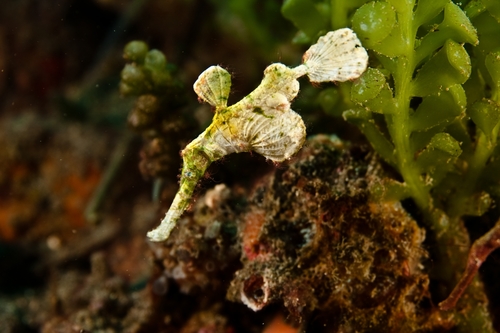
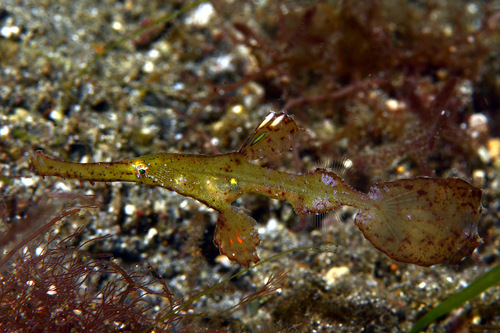
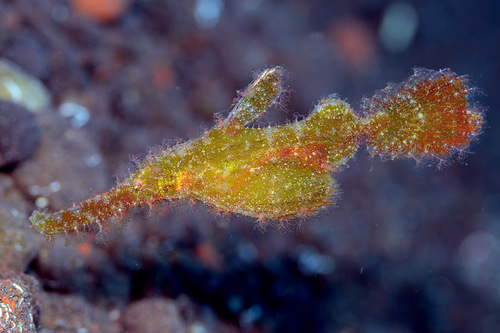
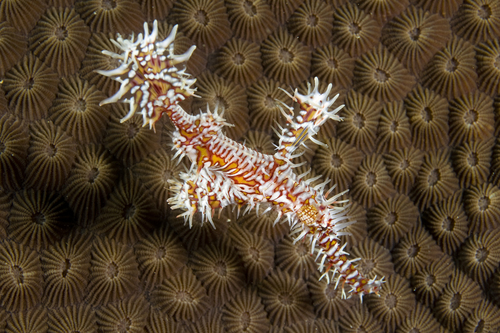
Solenostomus paradoxus (Pallas, 1770), commonly called the ornate ghost pipefish, has highly variable body coloration. Combined with its patterned body structures, this color variation greatly helps the species camouflage among its host organisms. Most individuals fall into either a light or dark color phase: light-phase individuals have yellow, orange, pink, white, and red pigments, while dark-phase individuals have deep brown, crimson, yellow, and black pigments. This pattern is not strict, however, as individuals can combine any number or type of these pigments, and some may even carry pigments not commonly seen in the species. It is characterized by a long, tubular, downward-facing snout and a short, deep caudal peduncle. It has a small toothless mouth, and lacks both a lateral line and scales. It typically holds an upright posture, has a prehensile tail, and a dermal skeleton made of multiple sequential star-shaped stellate plates that extend to the sides of the body. Numerous small spinules are present across the abdominal area, dorsal fins, pelvic fins, and beyond. There are clear sexual dimorphisms between females and males of this species: females are substantially larger and wider than males, with an average total length of 130 mm, while males are on average 37% smaller than females. Females also have a distinctive fused brood pouch, formed when their enlarged pelvic fins fuse with the abdomen along the dorsal margin to create a brood sac that holds their offspring. Early-stage larvae of S. paradoxus can be distinguished from adults by their smaller size, and by clusters of melanophores (melanin-containing cells that allow larvae to change color) located on the dorsal surface of the trunk, anterior to the gas bladder. Young S. paradoxus also have a small number of spines on the dorsolateral body, anterior to the anterior edge of the gas bladder. All fish in the family Solenostomidae inhabit tropical Indo-West Pacific waters. S. paradoxus specifically lives in Western Pacific and Indian Ocean waters along reef edges exposed to strong currents, ranging from the Red Sea to Tonga. It has been recorded off the coasts of Japan, Taiwan, Micronesia, Indonesia, and Australia, and in the South Pacific and South China Seas. Outside of its typically reclusive behavior, S. paradoxus is usually found either alone or in pairs. When selecting a habitat, individual S. paradoxus seek out and live on host organisms or substrates that match their individual coloration to improve camouflage; suitable hosts and substrates include gorgonians, corals, crinoids, hydroids, algae substrata, floating weeds, and seagrass beds. The high individual variation in body color allows the species as a whole to use a very wide range of different habitats. Due to its elusive nature, S. paradoxus specimens are rare. This has resulted in relatively few studies of the species, and limited understanding of its full geographic range. However, information gathered from the few collected specimens is slowly clarifying unknowns about the species' range, behavior, and preferred habitat. For example, a female specimen collected off the coast of Mainland India from a depth of 40 metres (130 ft) in the Arabian Sea provided a great deal of new information about the species. Insights into S. paradoxus' possible range can also be gained from the better-documented ranges of its close relatives, which occupy similar ecological niches and prefer similar habitats. A specimen of the related species Solenostomus cyanopterus collected at 23 metres (80 ft) depth as far east as the East Korean Sea gives additional context for the possible full range of the ornate ghost pipefish.