About Solenopsis geminata (Fabricius, 1804)
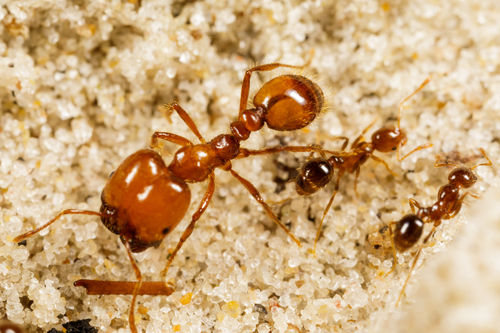
The tropical fire ant has the scientific name Solenopsis geminata (Fabricius, 1804). It is a species of fire ant belonging to the tribe Solenopsidini, and was originally described by Fabricius in 1804 when it was first placed in the genus Atta. This species has a pan-tropical distribution. It is native to Central and South America, including the Caribbean islands, but has spread across all tropics through human activity. It is an invasive species with a worldwide distribution that is larger than the distribution of other invasive fire ant species like Solenopsis invicta, the red imported fire ant. S. geminata constructs its nests primarily in soil in open, sunny locations. Nests form structures that can be craters or mounds, reaching up to 2 feet wide and 12 inches tall. Each nest has multiple entrance holes, with up to around 20 entrances per nest. The number of mounds per acre varies widely: native habitats hold between 10 and 80 mounds per acre, while introduced ranges can hold up to 1000 or even 1500 mounds per acre. Colonies of this species can be either monogyne (with a single queen) or polygyne (with multiple reproductive queens). S. geminata is known to hybridize with other closely related fire ant species. New colonies may be established by queens after a nuptial flight. Like other fire ants, this species can also spread by floating. Across global distances, it expands long range through jump-dispersal via human-mediated transport to invade new areas.