About Solena amplexicaulis (Lam.) Gandhi
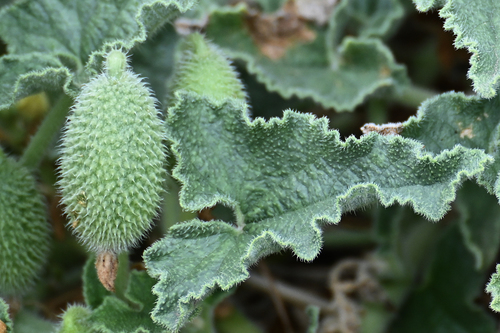
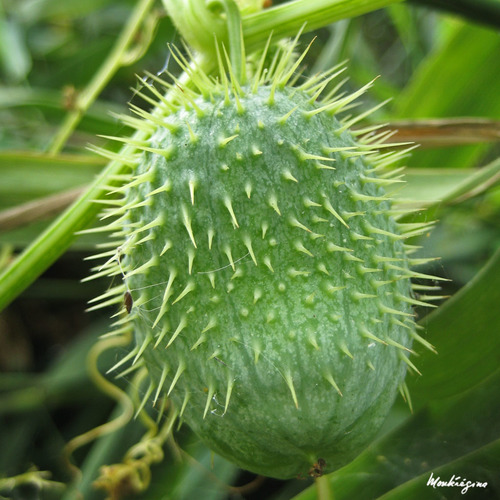
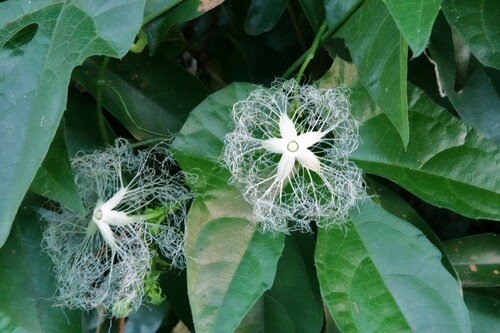
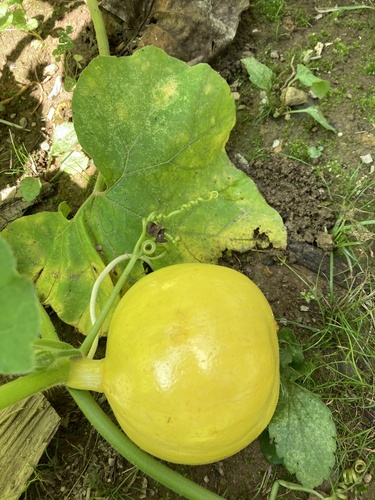
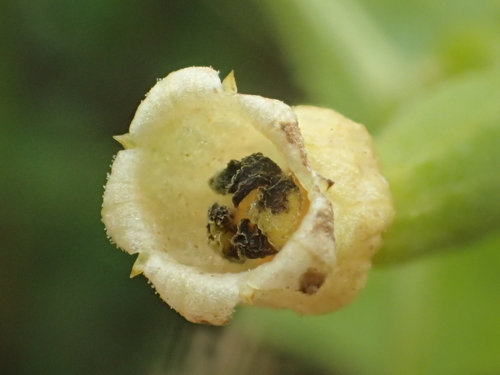
Solena amplexicaulis (Lam.) Gandhi is a perennial climbing plant with thick, tuberous roots. Its branched stem is hairless, and bears slender curling tendrils and alternate leaves with slender stalks that grow up to 1 cm (0.4 in) long. The leaf blades are leathery, ovate to oblong with heart-shaped bases and pointed tips. They reach up to 12 cm (5 in) long and 5 cm (2 in) wide, with entire or bluntly-toothed margins, and both upper and lower surfaces can be either bristly or smooth. This species is dioecious, meaning male and female flowers grow on separate individual plants. Flowers are produced in the leaf axils: male flowers are small, growing in short-stalked umbels holding 10 to 20 flowers each. Each male flower has a tubular calyx, with triangular petal tips protruding from it, and the flowers are creamy yellow. Female flowers are considerably larger and usually solitary, with three stigmas and ovoid inferior ovaries. The fruits grow up to 5 cm (2 in) long, and turn reddish-brown when they ripen. Its seeds are greyish-white, and shaped obovate or round. This species is distributed across Sri Lanka, Pakistan, India, Nepal, Bangladesh, Myanmar, Indonesia, Vietnam and China, growing at altitudes up to 2,600 m (8,500 ft). It occupies a variety of habitats, including tropical mixed forests, thickets, hilly areas, semi-cultivated areas and roadside verges. In India, unripe fruits of Solena amplexicaulis are harvested to use in salads and curries, and the shoots, leaves and tubers are also eaten in some regions of the country. In Chhattisgarh, people consume the fruits and roots to help digest bushmeat. This plant, commonly called creeping cucumber, can be collected from the wild, or cultivated as a field crop with suitable supports provided for it to climb over. In traditional medicine, the tuberous roots of this plant are used to treat anorexia, digestive problems, flatulence, asthma, gonorrhoea and spermatorrhoea. Leaf extracts are widely used to treat inflammation. An ethanol extract made from the tuberous roots shows antioxidant, antimicrobial and analgesic properties, but is moderately toxic.