About Solecurtus strigilatus (Linnaeus, 1758)
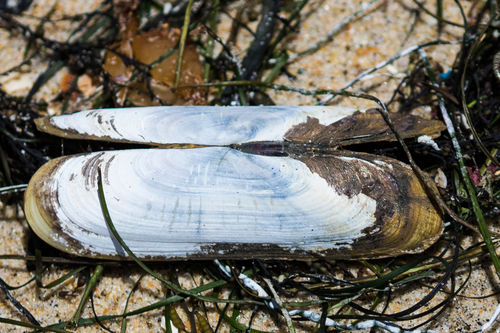
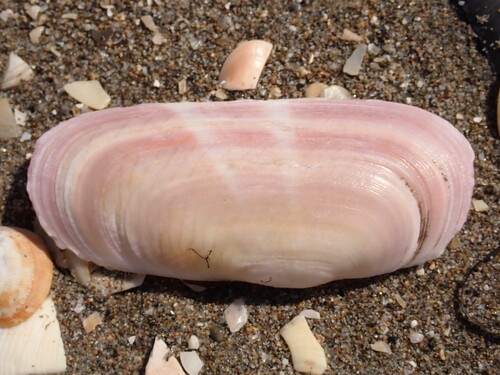
The rosy razor clam, scientifically named Solecurtus strigilatus (Linnaeus, 1758), has relatively small, thin valves with fine sculpture. A strong, protruding foot sits at the anterior end of the animal. At the posterior end is a large mantle sac that holds the gills; when relaxed, this sac protrudes to twice the length of the valves, but it can contract back to sit between the valves. Behind this mantle sac are two robust, contractile siphons. The maximum length of this clam's shell is 8 cm (3 in). This species occurs in the Mediterranean Sea and the adjacent area of the Atlantic Ocean. It can be found from the lower shore down to the shallow sublittoral zone. Solecurtus strigilatus lives immersed in soft sediment, most commonly medium-grade sand. It constructs a J-shaped burrow lined with mucus. The clam extends its two siphons up to the sediment surface to feed, and when it is not feeding it burrows deeper, often residing 50 cm (20 in) below the sand surface. While many clams are detritivores that consume decomposing organic matter from their surroundings, this species is a filter feeder: it draws water in through one siphon, filters out edible particles, and expels water out through the second siphon. It can dig through sand very quickly; if a human tries to dig it out, it will move diagonally downward even deeper into the sediment. To distract predators, it can shed the tips of its two siphons, which continue to pulsate as they drift through the water column. The lost siphon tips can be fully regenerated. The clam's presence in sediment is marked by two circular holes, each 1 cm (0.4 in) wide and positioned 2 cm (0.8 in) apart, that the siphons extend through. Digging in this species follows a five-phase cycle. First, the mantle sac and siphons fill with water while the foot stays contracted. Next, the siphons close, forcing water into the mantle sac as the foot unfolds. Then, the mantle sac contracts to shoot a jet of water into the sediment in front of the foot. After that, the foot is pushed into the newly loosened sediment. Finally, the tip of the foot expands to form an anchor, and the clam pulls its body downward, ready to begin the next digging cycle.