About Solea senegalensis Kaup, 1858
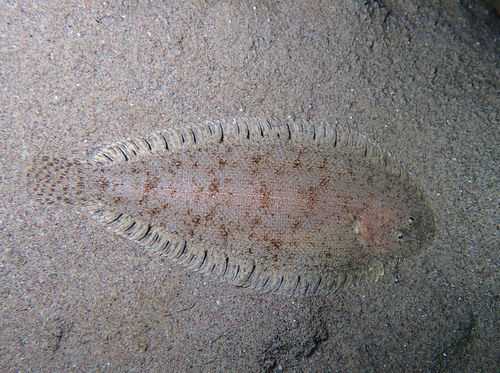
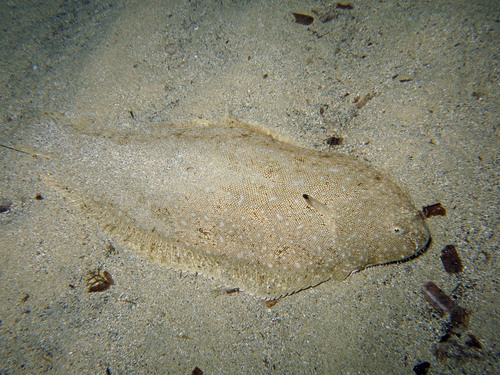
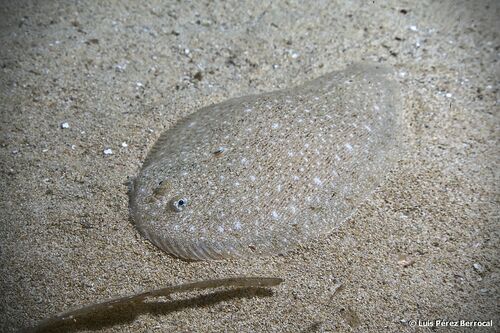
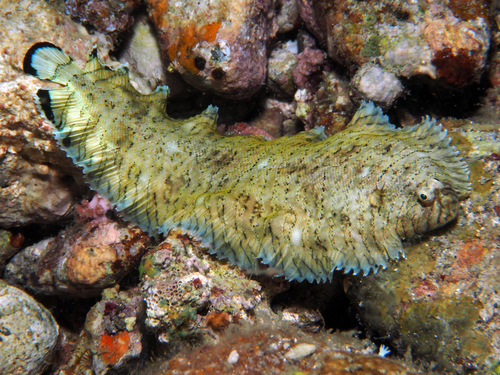
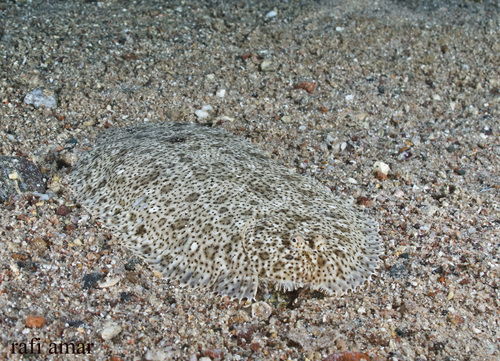
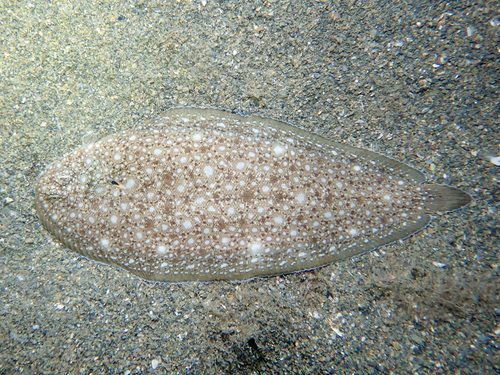
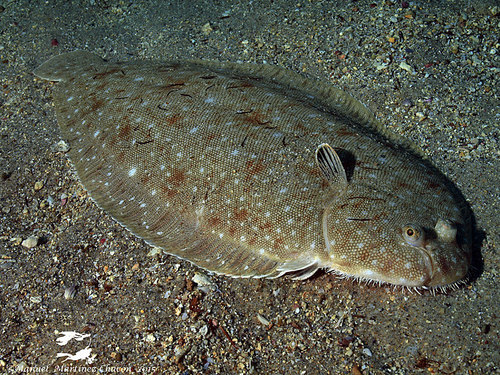
The Senegalese sole, Solea senegalensis Kaup, 1858, is very similar to the common sole. Like the common sole, it has a flattened, oval body, with its dorsal fin starting on the upper profile of the head, in front of the upper eye. Its dorsal fin has 73 to 86 rays, the anal fin has 61 to 74 rays, and a well-developed pectoral fin with 7 to 10 rays grows on each side of the body. A narrow membrane connects the caudal fin to the last rays of the dorsal and anal fins. There are many small, hair-like fringes on the blind side of the head, and the distance between the upper eye and the dorsal profile of the head is larger than the diameter of the eye. The anterior nostril on the blind side is surrounded by a small ridge, but it is not enlarged. The lateral line is formed by 120 to 138 pored scales. On its eyed side, the Senegalese sole is greyish brown and marked with many blue spots, which tend to fade away in dead specimens. Its blind side is whitish. The membrane of the eyed-side pectoral fin is nearly black, contrasting with its cream-colored fin rays. This trait distinguishes Senegalese sole from common sole; common sole have a distinct black spot near the margin of the pectoral fin instead. Senegalese sole can reach a standard length of 60 cm, but most individuals are around 45 cm long. Originally, Senegalese sole occurred only in the eastern Atlantic, ranging from southern Great Britain and Ireland, where it is rare, south to Angola, including the Canary Islands. It is believed to have invaded the Mediterranean Sea through the Strait of Gibraltar in the early 20th century. It spread rapidly through the western Mediterranean basin, and can now be found as far east as the Aegean Sea and the Sea of Marmara. It is also found along the southern coast of the Mediterranean, including off Tunisia, where it is an important natural resource. Senegalese sole is a demersal flatfish that lives on sandy or muddy bottoms across a variety of habitats, from brackish lagoons and shallow waters to coastal regions up to 100 m deep. Adult Senegalese sole feed mainly on small benthic invertebrates such as polychaetes and bivalves, as well as small crustaceans. Females reach sexual maturity at around 3 years of age, when they are typically 30 cm in total length. Spawning occurs during the summer; around the Iberian Peninsula, spawning peaks in June when water temperatures are between 15 °C and 20 °C.