About Solanum virginianum L.
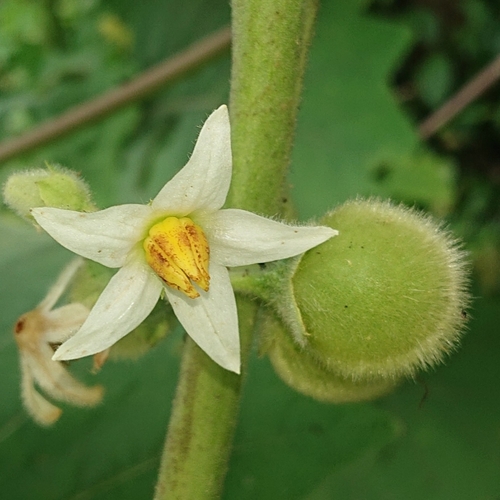
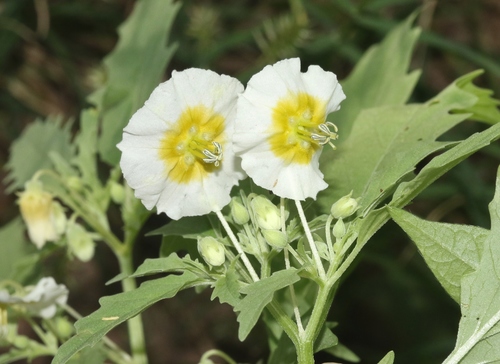
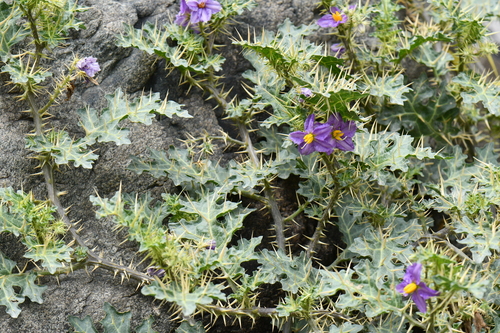
Yellow-fruit nightshade (Solanum virginianum L.) is an erect herb that is sometimes woody at the base, growing 50–70 cm (20–28 in) tall. It is covered abundantly with sturdy, needle-like prickles that have broad bases, measuring 5–20 mm long and 0.5–1.5 mm wide. Its leaves are ovate-oblong, sinuated, and arranged in unequal pairs; leaf blades measure 4–9 cm × 2–4.5 cm, with an acute apex, unequal lobes, and are either pinnate or typically have 5 to 9 lobes. Both the leaf veins and leaf stalks have prickles, and the leaf stalks measure 2–3.5 cm in length. The plant produces a 4–7 cm long racemose inflorescence, with a bell-shaped sepal tube 1 cm in diameter. The blue-purple flowers measure 1.4–1.6 cm × 2.5 cm. Petals are ovate-deltate, 6–8 mm long, and densely covered in stellate hairs. Filaments measure 1 mm, anthers 8 mm, and the style 1 cm. Fruiting pedicels are 2–3.6 cm long, bearing prickles and sparse stellate hairs; fruiting sepals are prickly and sparsely pubescent. The plant produces pale yellow berries 1.3–2.2 cm in diameter, and ripe yellow fruits reach around 3 cm in diameter. Its typical flowering period runs from November to May. Studies have tested in-vitro antioxidant and in-vivo antimutagenic properties of extracts from Solanum xanthocarpum seeds, via qualitative phytochemical screening that found polyphenols, flavonoids, glycosides, alkaloids, carbohydrates, and reducing sugars in the plant. Following this preliminary qualitative screening, researchers also performed quantitative estimation of polyphenol content in the plant. The quantitative analysis found alcoholic extracts contain significant higher amounts of polyphenols than aqueous extracts. In-vitro antioxidant activity was tested using two methods: DDPH and a superoxide radical scavenging method. Alcoholic extracts showed significantly stronger antioxidant properties than aqueous extracts. Because of the observed polyphenol content and antioxidant activity, alcoholic extracts were used for an antimutagenic (clastogenic) test. These alcoholic extracts produced significant positive results for antimutagenic activity.