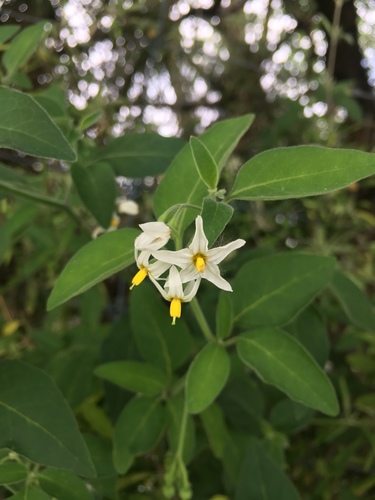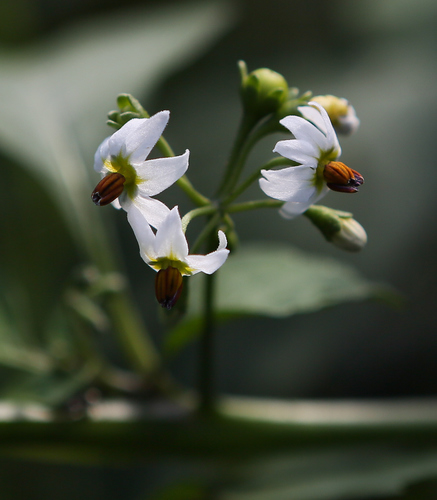
About Solanum tuberosum L.
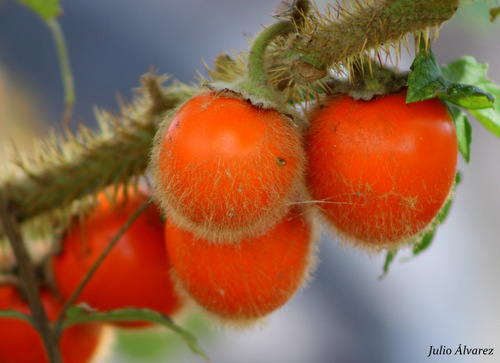
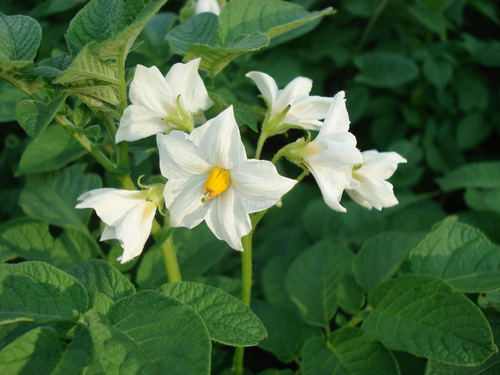
Potato (Solanum tuberosum L.) plants are herbaceous perennials that reach a maximum height of 1 metre (three feet). Their stems are hairy, and their leaves typically have roughly four pairs of leaflets. The plant's flowers, which range in color from white or pink to blue or purple with yellow centers, are pollinated by insects. Potato plants develop nutrient-storing tubers, which are modified stems rather than roots; they form from thickened rhizomes at the tips of long, thin stolons. The surface of tubers has indentations called "eyes", which act as protective sinks for the vegetative buds that new stems grow from. These eyes are arranged in a spiral pattern. Tubers also have small circular breathing holes called lenticels; their number varies based on the size of the tuber and surrounding environmental conditions. Tuber development is triggered by decreasing day length, though this tendency has been greatly reduced in commercial potato varieties. After flowering, potato plants produce small green fruits that resemble green cherry tomatoes, each containing around 300 very small seeds. Raw potatoes contain toxic glycoalkaloids, the most common of which are solanine and chaconine. Solanine occurs naturally in other members of the Solanaceae plant family, which includes toxic species such as deadly nightshade (Atropa belladonna) and henbane (Hyoscyamus niger), tobacco (Nicotiana spp.), and edible food plants like tomato. These glycoalkaloid compounds protect the potato plant from predators, and are most concentrated in the above-ground aerial parts of the plant. Tubers normally have low levels of these toxins, unless the tuber is exposed to light, which causes it to turn green. Exposure to light, physical damage, and age all increase the glycoalkaloid content of potato tubers. Different potato varieties have different naturally occurring levels of glycoalkaloids. The 'Lenape' potato variety, released in 1967, was withdrawn from sale in 1970 because it contained high levels of glycoalkaloids. After this incident, breeders developing new potato varieties test for glycoalkaloid content, and sometimes discard otherwise promising cultivars. Breeders aim to maintain glycoalkaloid levels below 200 mg/kg (0.0032 oz/lb). Even so, when commercial varieties turn green, their solanine concentrations can rise well above this limit, with the highest levels found in the potato's skin. Potatoes have several non-food uses. They are sometimes used to brew alcoholic spirits including vodka, poitín, akvavit, and brännvin. They are also used as fodder for livestock, and can be processed into silage that can be stored for several months before use. Potato starch is used in the food industry as a thickener and binder for soups and sauces; in the textile industry as an adhesive; and in the paper industry for manufacturing paper and board. Potatoes are also commonly used in plant research. Their consistent parenchyma tissue, clonal growth habit, and low metabolic activity make potato an ideal model tissue for wound-response studies and experiments on electron transport.