About Solanum torvum Sw.
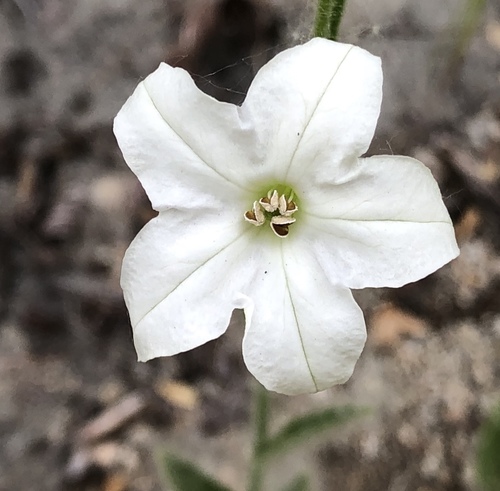
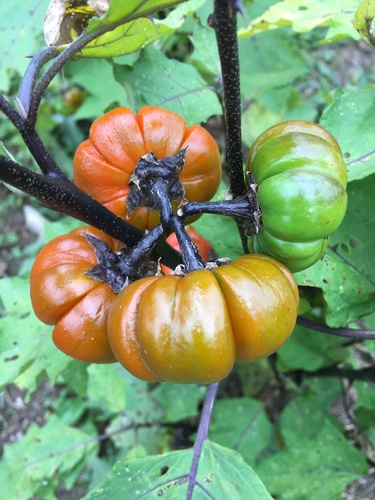
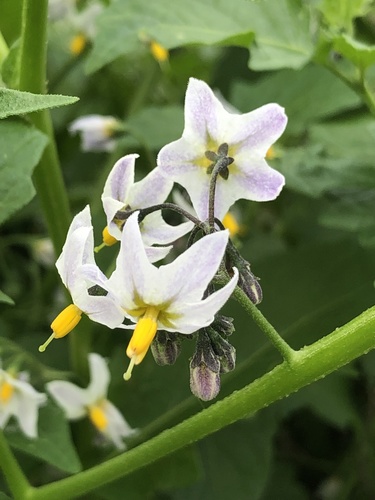
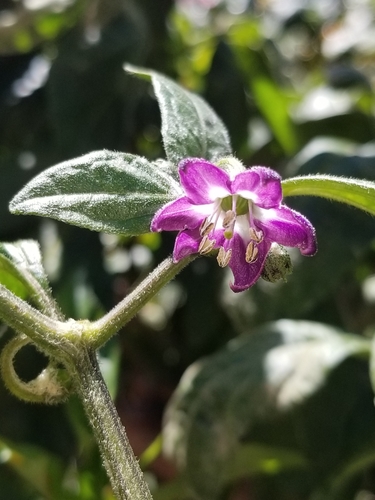
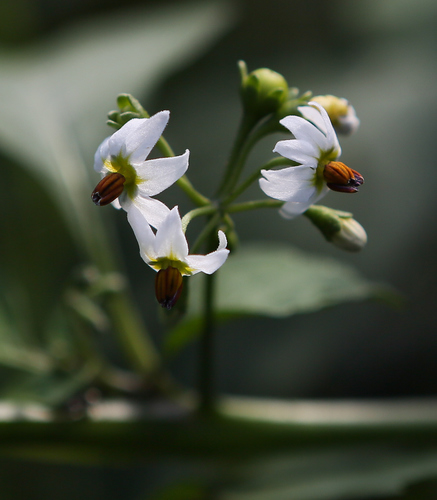
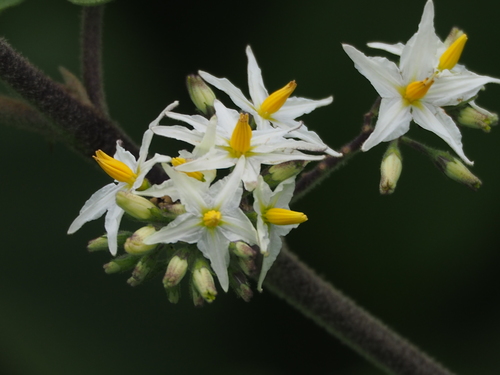
Solanum torvum Sw., commonly called turkey berry, is typically 2 to 3 meters tall with a 2 cm basal diameter, though it can grow as tall as 5 meters with an 8 cm basal diameter. This shrub usually grows a single stem at ground level, but may branch on its lower stem. The stem bark is gray, nearly smooth, and marked by raised lenticels. The inner bark features a green layer over an ivory-colored section. Plants the author examined growing on firm soil had weak taproots, well-developed lateral roots, and all roots were white. Foliage only grows on the newest growing twigs. Twigs are gray-green, covered in star-shaped hairs. Short, slightly curved spines occur across the entire plant including leaf midribs; spines can be thick or entirely absent. Leaves grow opposite each other or one per node, and are broadly ovate with either entire edges or deep lobes. Leaf petioles are 1 to 6 cm long, and leaf blades measure 7 to 23 cm long by 5 to 18 cm wide, and are covered in short hairs. Flowers are white, tubular with 5 pointed lobes, grouped in corymbiform cymes, and are shed soon after opening. Fruits are berries that grow in clusters of tiny green spheres approximately 1 cm in diameter, resembling green peas. Fruits turn yellow when fully ripe, have thin flesh, and contain numerous flat, round, brown seeds. After shrubs reach a height of around 1 to 1.5 meters, they flower and fruit continuously. Ripe fruits collected in Puerto Rico had an average weight of 1.308 ± 0.052 g. Air-dried seeds from these fruits averaged 0.00935 g per seed, which equals 1,070,000 seeds per kilogram. When sown on commercial potting mix, 60 percent of these seeds germinated between 13 and 106 days after sowing. Seedlings are very common in recently disturbed ground. Frugivorous birds eat the fruits and spread the seeds. Turkey berry can also be propagated vegetatively by placing branch cuttings, with or without leaves, in a mist chamber for one month. In Puerto Rico, turkey berry grows in upland sites that receive 1000 to 4000 mm of annual precipitation, and also grows in riparian zones in drier areas. It grows on all types of moist, fertile soil at elevations from near sea level to almost 1,000 m in Puerto Rico, and up to 2,000 m in Papua New Guinea. When given an equal start after disturbance, turkey berry quickly grows taller than most herbs, grasses, and other shrubs. It grows best in full sunlight, grows well in light shade or partial daily shade, but cannot survive under a closed forest canopy. Single turkey berry plants, groups, and thickets are most often found on roadsides, vacant lots, brushy pastures, recently abandoned farmland, landslides, and river banks. It is classified as invasive in New Caledonia, where it was likely introduced in 1900.