About Solanum petrophilum F.Muell.
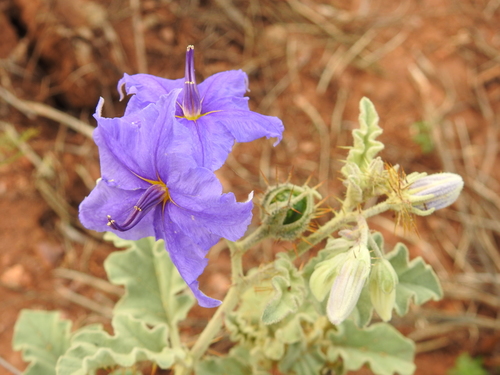
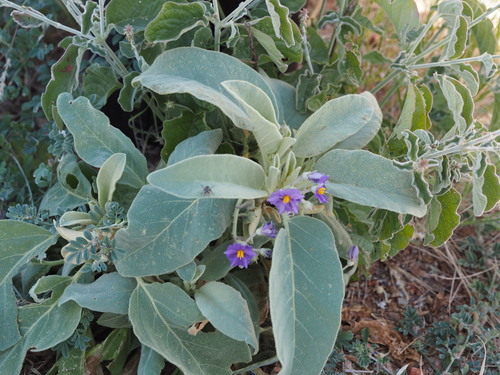
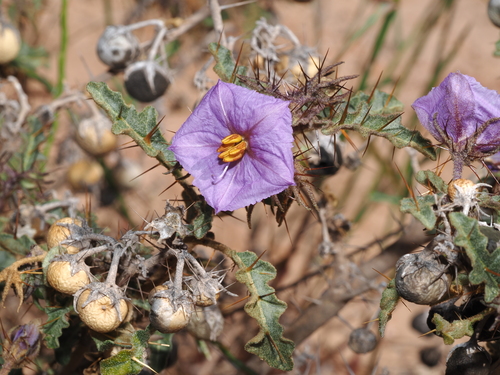
Solanum petrophilum F.Muell. is a small, heavily branched prickly shrub, growing 20 to 60 cm (8 to 24 inches) tall, and sometimes grows with a sprawling habit. All parts of this plant, except its petals, have sparse to moderately dense stellate hair tomentum, plus an additional covering of straight prickles that measure up to 1 cm (0.4 in) long. The prickles range in color from reddish to brownish, and they occur in smaller numbers than those found on other species in the S. petrophilum complex. Solanum petrophilum is widespread across arid regions of inland Australia. It is found most commonly in South Australia, specifically the Gawler and Flinders Ranges, with additional populations in the Northern Territory, the Coolgardie area of Western Australia, and the sandplain and sandstone hills of New South Wales near Broken Hill. It favors habitats on rocky hills and outcrops, or near the base of mountain ranges, but it can also grow in a range of other sites including creek banks and undulating plains. The berries of S. petrophilum have long been considered toxic to livestock, though no conclusive evidence has confirmed this assumption. This suspected toxicity is thought to be caused by toxic steroidal glycoalkaloids in the berries, which can be harmful if ingested. These compounds are a natural defense found in many Solanum species against snails and insects, and they may also suppress the germination of other competing plants. While some other native Australian Solanum species, such as S. centrale, are important food sources in arid Australia (even though they remain toxic when unripe), S. petrophilum is still regarded with caution and avoided as a food by humans. By contrast, studies of Yellow-footed Rock Wallabies (Petrogale xanthopus) found that S. petrophilum is a major component of the species' diet, particularly in summer and autumn when fruit is abundant and other herbs make up a smaller proportion of available food.