About Solanum melongena L.
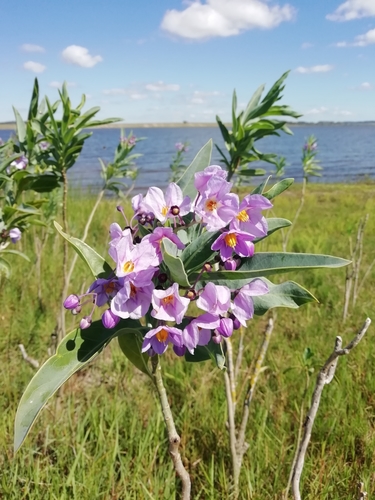
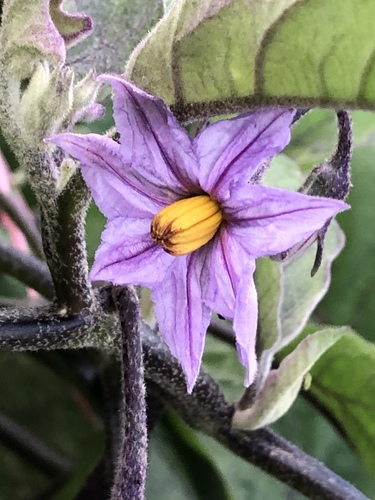
Solanum melongena L., commonly known as eggplant, is a delicate tropical perennial plant that is often grown as a tender or half-hardy annual in temperate climates. Its stems are frequently spiny, and cultivated plants reach 40 to 150 cm (1 ft 4 in to 4 ft 11 in) in height. The plant bears large, coarsely lobed leaves that are 10 to 20 cm (4 to 8 in) long and 5 to 10 cm (2 to 4 in) broad. Semiwild types can grow much larger, reaching up to 225 cm (7 ft 5 in) tall, with leaves that grow over 30 cm (12 in) long and 15 cm (6 in) broad. Its flowers range from white to purple, have a five-lobed corolla, and contain yellow stamens. Botanically, the edible fruit of eggplant is classified as a berry. It holds numerous small, soft seeds that have a bitter taste, because they contain or are coated in nicotinoid alkaloids, similar to the related tobacco plant. Many common cultivars produce egg-shaped, glossy, purple fruit with white flesh that has a spongy, meaty texture. Other cultivars have longer, white fruit. Wild eggplants produce fruit that measures less than 3 cm (1+1⁄4 in) in diameter. When cut fruit flesh comes into contact with oxygen from the air, it quickly turns brown. For cultivation in tropical and subtropical climates, eggplant can be sown directly in an outdoor garden. In temperate climates, eggplant grows best when transplanted into the garden after all risk of frost has passed. Eggplant requires hot weather; when grown in cold climates or low-humidity areas, the plants struggle or fail to set and produce mature fruit. Seeds are generally started indoors eight to 10 weeks before the expected last frost date. Solanum melongena is listed as a low flammability plant, meaning it is suitable for planting within building protection zones. Space plants 45 to 60 cm (18 to 24 in) apart, with spacing adjusted by cultivar, and space rows 60 to 90 cm (24 to 35 in) apart, adjusted based on the cultivation equipment used. Mulching helps conserve soil moisture, prevent weeds, and reduce fungal disease, and plants benefit from partial shade during the hottest part of the day. Shaking flowers to perform hand pollination improves fruit set of the first blossoms. Growers typically cut fruits from the vine just above the calyx, because the stems are somewhat woody. Eggplant flowers are complete, containing both female and male reproductive structures, and can be pollinated either by self-pollination or cross-pollination. Many pests and diseases that affect other solanaceous plants, including tomato, capsicum, and potato, also cause problems for eggplants. For this reason, eggplant should generally not be planted in areas that recently grew these close relatives. Because eggplants are especially susceptible to pests such as whiteflies, they are sometimes grown alongside slightly less susceptible plants like chili pepper, which act as a sacrificial trap crop. To reduce pest pressure, successive crops of eggplant should be planted four years apart. Common pests of eggplant in North America include potato beetles, flea beetles, aphids, whiteflies, and spider mites. Good sanitation and crop rotation practices are very important for controlling fungal disease, the most serious of which is Verticillium. The potato tuber moth (Phthorimaea operculella) is an oligophagous insect that prefers to feed on solanaceous plants such as eggplant. Female Phthorimaea operculella lay their eggs on eggplant leaves, and the hatched larvae feed on and consume the leaf mesophyll. Several different Phytoplasmas cause little leaf of brinjal, a disease that is agriculturally significant in South Asia. This disease is spread by the leafhopper Hishimonus phycitis.