About Solanum lycopersicum L.
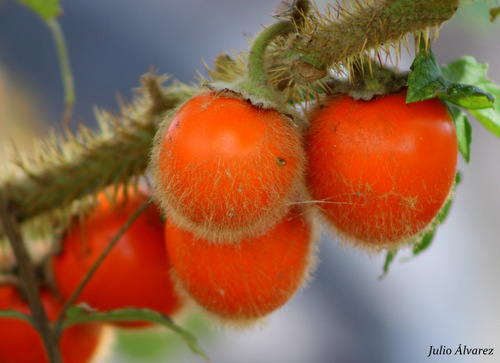
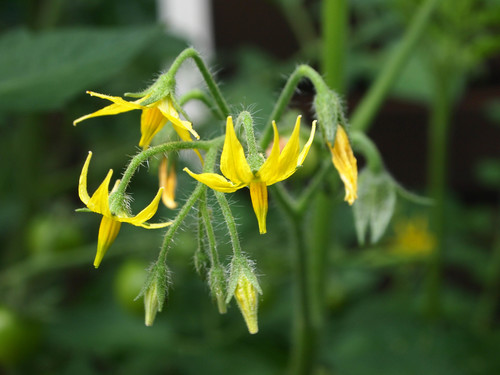
Solanum lycopersicum L., the tomato, most commonly grows as a decumbent vine that can reach 3 meters (9.8 feet) in length, while bush tomato varieties typically grow no taller than 100 centimeters (3 feet 3 inches). Tomato plants are tender perennials that are very often grown as annuals, and they are classified as dicots. Their growth occurs as a sequence of branching stems, with a terminal bud at the tip that carries out active growth. If the terminal bud stops growing — whether due to pruning or flowering — lateral buds take over and grow into new fully functional vines. Tomato vines are typically pubescent, meaning they are covered in fine short hairs. These hairs aid the plant's vining growth, and can develop into roots anywhere the vine touches the ground and moisture; this root development is especially common if the vine's connection to its original root system has been damaged or cut off. Tomato leaves measure 10 to 25 centimeters (4 to 10 inches) long, and are odd pinnate with five to nine leaflets attached to petioles. Each individual leaflet can grow up to 8 centimeters (3 inches) long, and has a serrated margin. Both stems and leaves are densely covered in glandular hairs. Tomato flowers are bisexual and capable of self-fertilization. When tomatoes were moved away from their native ranges, their original traditional pollinators — most likely a species of halictid bee — did not travel with them. This made self-fertility a useful advantage, so domestic tomato cultivars have been selectively bred to maximize this trait. Despite common claims that tomatoes self-pollinate, self-fertility is not the same as self-pollination. Greenhouse growing clearly demonstrates that tomatoes pollinate themselves poorly without outside assistance: in greenhouses, pollination must be helped along with artificial wind, plant vibration, or cultured bumblebees. Flowers develop on the apical meristem. Their anthers are fused along their edges, forming a column that surrounds the style of the pistil. The anthers curve into a cone-shaped structure that surrounds the stigma. Flowers are 1 to 2 centimeters (0.4 to 0.8 inches) across, yellow, with five pointed lobes on the corolla, and grow in cymes that hold three to twelve flowers each. The fruit develops from the plant's ovary after fertilization, and its fleshy interior is made up of pericarp walls. The fruit contains locules, which are hollow spaces filled with seeds. Locule structure varies widely between cultivated varieties: some smaller varieties have two locules; globe-shaped varieties typically have three to five; beefsteak tomatoes have a large number of small locules; and plum tomatoes have very few, very small locules. To grow tomatoes from seed, seeds must be collected from a fully mature fruit, lightly fermented to remove the gelatinous outer coating around each seed, then dried before planting. Tomato plants form a mutualistic relationship with arbuscular mycorrhizal fungi such as Rhizophagus irregularis, and scientists use the tomato as a model species to study this type of symbiosis. After Spanish conquistador Hernán Cortés captured Tenochtitlan in 1521, this event launched the widespread cultural and biological interchange known as the Columbian exchange. The tomato was being cultivated in Europe by the 1540s, only a few years after 1521, and grew well in Mediterranean climates. The earliest mention of the tomato in European literature appears in Pietro Andrea Mattioli's 1544 herbal, where he suggested a new type of eggplant had been brought to Italy. He noted that it turned blood-red or golden when mature, could be cut into segments, and eaten like an eggplant: cooked and seasoned with salt, black pepper, and oil. Ten years later, Mattioli published the name pomi d'oro, or 'golden apples', for the fruit. It was likely eaten soon after its introduction to Europe, and tomatoes were being used as food in Spain by the early 17th century. This is documented in Lope de Vega's 1618 play La octava maravilla, which references 'lovelier than ... a tomato in season'. Following Spanish colonization of the Americas, the Spanish spread the tomato across all their Caribbean colonies. After they introduced it to the Philippines, it spread to Southeast Asia, and eventually across the rest of Asia. Today, the tomato is grown worldwide for its edible fruits, and thousands of cultivars exist. Greenhouse cultivation of tomatoes, in both large-scale commercial greenhouses and small stand-alone or multiple-bay owner-operator greenhouses, is growing. Greenhouse production makes tomatoes available during seasons when field-grown tomatoes cannot be easily obtained. Small cherry and grape tomatoes, as well as cluster (fruit-on-the-vine) tomatoes, are the types most often grown by large commercial greenhouse operators, while beefsteak varieties are the most common choice for smaller owner-operator growers. Tomatoes are also commonly grown using hydroponic methods.