About Solanum lycocarpum A.St.-Hil.
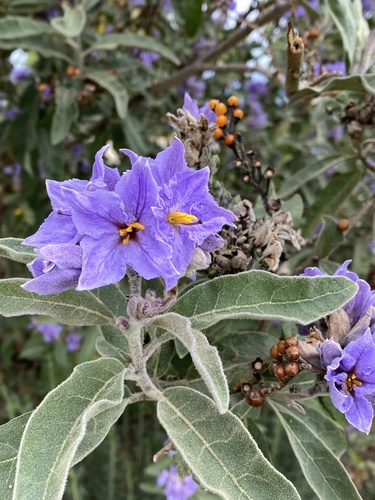
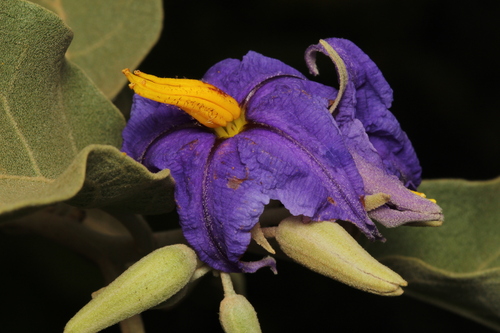
Solanum lycocarpum A.St.-Hil., commonly known as the wolf apple plant, is a flowering shrub or small tree with a round open crown, growing 1.2 to 5 m (4 to 16 ft) tall. Its large leaves, arranged in an alternate pattern, are 16 to 28 cm (6 to 11 in) long, simple in structure but deeply lobed, tough in texture, and covered in a soft grey-white fuzz. Wolf apple plants flower year-round, with the heaviest flowering during the dry season from late fall to early spring. Their flowers resemble those of bitter nightshade: they are star-shaped, with five sepals, five blue or purple petals fused at the base, and five large yellow anthers that release pollen through an opening at the tip. The flowers grow in a helical monochasal cyme arrangement, opening from the base upward. Flowers do not produce nectar, and are either male or hermaphroditic; only hermaphroditic flowers produce fruit after cross-pollination by multiple species of pollen-collecting bees: Xylocopa virescens, X. frontalis, Oxaea flavescens, Centris scopipes, C. fuscata, Bombus morio, Exomalopsis sp., Pseudaugochloropsis graminea, Apis mellifera, and Megachile benigna. Most fruit production occurs between December and January. The fruits are large, reaching up to 20 cm (8 in) in diameter and weighing 900 g (2 lb) or more. Each fruit contains up to 500 dark brown, comma-shaped seeds that measure approximately 7 mm × 5 mm × 2 mm (1⁄4 in × 3⁄16 in × 1⁄16 in). The fruit’s rind is thin and lustrous, and stays green even when the fruit is fully ripe. The pulp is yellowish, soft, sweetish, and extremely aromatic. Externally and internally, the fruit resembles a tomato, while its flesh texture and color are similar to that of an eggplant. The maned wolf acts as an important seed-dispersing agent for this plant. The wolf apple is native to the Brazilian savannah, and also grows on pastures and disturbed land such as highway margins across various parts of Brazil. It prefers moist, clay soil, full sun, and mild temperatures. Ripe wolf apple fruits are edible for humans, and local populations consume them in jams and preserves. Unripe fruits are high in tannin. During the dry season, the fruits serve as a fallback food source for cattle. At the start of maturation, the entire fruit is 85% moisture by weight, 5% starch, and 10% other residue. Dry pulp, with peel and seeds removed, yields over 50% starch—more than cassava. Locally, starch is extracted by blending the fruit with water and straining the mixture. The pulp of a ripe fruit contains approximately 75% moisture, 11% carbohydrate, 1% fat, 1% protein, 1% ash, 2.5% soluble fiber, and 2% insoluble fiber. The main volatile compounds that give the ripe fruit its aroma are hexanal, which carries a grass scent, and ethyl butanoate, which carries an apple scent; dozens of other compounds also contribute to the fruit’s aroma. All other parts of the plant are poisonous to humans. Cattle eat the plant’s leaves, and the leaves are also an important food source for the bat Platyrrhinus lineatus. There are currently no proven medicinal uses for wolf apple, but the plant is used in local folk medicine to treat obesity, reduce cholesterol, and manage diabetes. Around 30% of the starch extracted from almost-ripe fruits, which is sold commercially in capsule form, is digestion-resistant; this is cited as the reasoning for its popular folk uses. Studies have found that high-fiber Solanum lycocarpum flour reduces diabetes symptoms in diabetic rats, but the extracted starch did not produce this effect. Dried wolf apple fruits contain around 1.5% glycoalkaloids, mostly solamargine and solasonine, which are concentrated mainly in the peel and seeds. In vitro tests have shown that extracts from the plant kill the human parasites Schistosoma mansoni, Giardia lamblia, Leishmania amazonensis, and Leishmania infantum. The main phenolic compounds found in ethanol extracts of ripe fruits are caffeic acid and chlorogenic acid. It is thought that wolf apple fruits protect maned wolves from infection with the giant kidney worm, which is usually fatal to the animal. Solanum lycocarpum fruit extracts have also been shown to kill larvae of the Culex mosquito.