About Solanum laciniatum Aiton
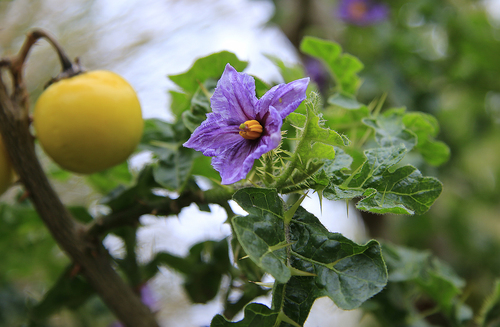
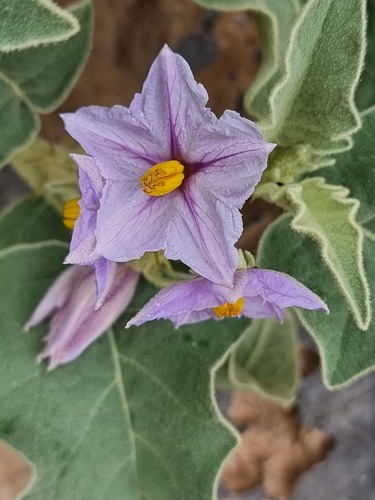
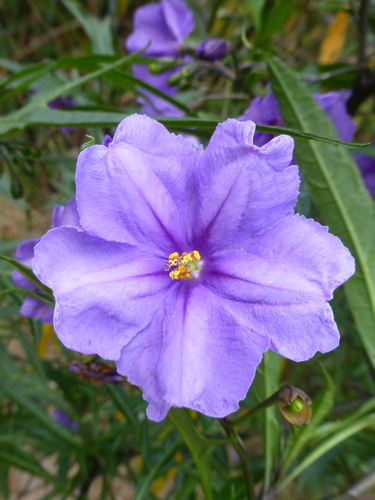
Solanum laciniatum Aiton is a hardy, short-lived, glabrous perennial shrub. It typically grows 1 to 3 metres tall and wide, occasionally reaching up to 4 metres in height. It has a spindle-shaped root system made up of many branching roots that grow 20 to 30 centimetres deep into the ground. Its leaves are around 8 to 30 centimetres long, and sometimes have large marginal teeth. Flowers range in colour from white to dark blue-violet (often described as purple-blue or bright purple), measure 25 to 40 millimetres wide, have yellow anthers, and are distinctly divided into five petals—a feature that distinguishes it from many other Solanum species. While it most commonly blooms between January and February, it can flower and produce fruit year-round. Its fruit ranges from bright orange-red to deep scarlet-red, and is around 10 to 15 millimetres wide. Its seeds are 2.2 to 2.5 millimetres in diameter, and can likely remain dormant in soil for long periods; the species typically emerges after soil disturbance. It can grow from semi-hardwood cuttings, but grows best directly from seed, and is fast-growing in suitable conditions. This species is indigenous to New Zealand’s North Island, South Island, Stewart Island, and Chatham Islands, and is also native to southeastern Australia and Tasmania. It has become naturalized in parts of Russia and China, where it escaped cultivation and reproduces freely in the wild without human assistance. It grows in well-drained soil in full sun or partial shade, and often colonizes disturbed soil and tracks. It can tolerate moderately salty winds, and occurs from coastal to montane areas up to 400 metres above sea level. It is most often found in recently disturbed habitats such as areas damaged by fire, and also grows in shrublands, along rivers, in gullies, and in forested areas. Though common in wild habitats, it is also a common weed in many New Zealand urban areas. Māori have traditionally used this species in medicinal practices: leaves are beaten into a pulp to treat skin sores, processed into an oil for wound treatment, or applied whole directly to wounds. Ripe berries were traditionally eaten as food, and leaves were occasionally used to line hāngī to add flavor to cooked foods—though this practice is no longer recommended because the plant’s leaves contain poisonous alkaloids. Early European settlers to New Zealand also ate the fruit, stewing it to make pies or jams, and called the fruit bull-a-bull or Māori gooseberries. Solanum laciniatum was previously grown commercially in Taranaki, New Zealand and by the former Soviet Union to produce steroid hormones used for birth control and to relieve symptoms of rheumatoid arthritis. Like other species in the Solanum genus, Solanum laciniatum contains solasodine, a pharmaceutically important chemical compound. Naturally occurring steroid glycoalkaloids from solasodine are an important resource for the synthesis of corticosteroids and contraceptives in modern medicine.