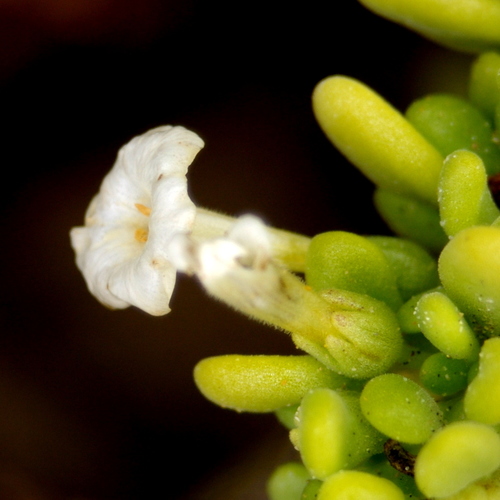
About Solanum esuriale Lindl.
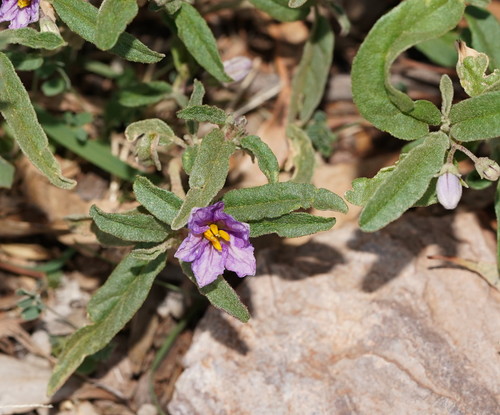
Solanum esuriale Lindl. is a green-grey plant that grows 15 to 30 cm tall, with branches growing at or near the ground. Unlike most other Solanum species, it usually does not have prickles; any prickles that are present are sparse and located towards the base of the plant. The entire plant is covered in dense, pale stellate hairs. Its leaves are oblong or oblong-lanceolate in shape: lower leaves measure 5 to 8 cm long, while adult leaves are typically shorter, at 3 to 7 cm long.
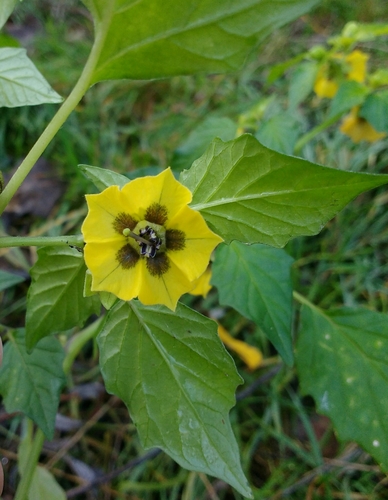
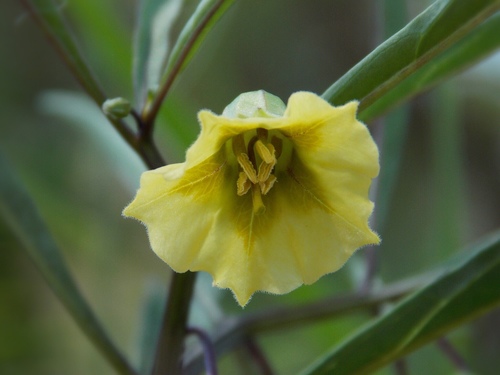
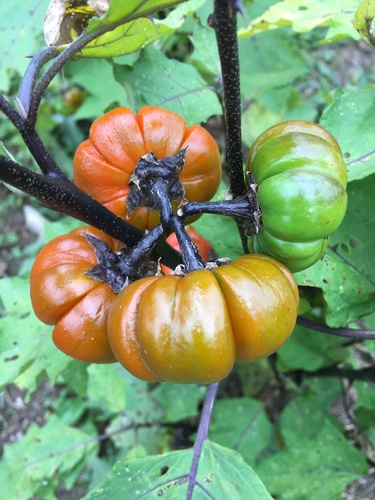
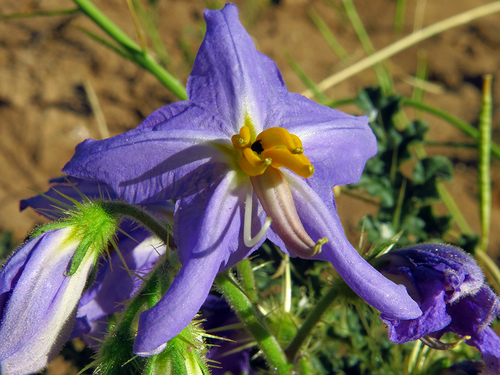
Flowers grow in cymes of 2 to 6 flowers. Each flower is 5-pointed star-shaped, most often purple, with 5 yellow anthers that are 3 to 5 mm long. The berry is spherical or ovoid, 10 to 15 mm in diameter, and has a pointed base. Unripe berries are pale green, and ripen to light yellow or brown, and the berry never has stripes at any growth stage. Seeds are 2–3 mm long, and pale yellow-brown.
This species may be confused with many other Solanum species that share overlapping distributions, including western nightshade (S. coactiliferum), potato bush (S. cleistogamum), and silverleaf nightshade (S. elaeagnifolium); silverleaf nightshade is invasive to Australia and classified as a noxious weed. Variation in leaf shape among other Solanum species makes differentiation difficult outside the summer to autumn fruiting season. The pointed base and lack of stripes on the berry are distinguishing features of quena, the common name for S. esuriale.
Solanum esuriale is found across mainland Australia, with its primary distribution in the arid zones of Victoria, New South Wales, South Australia, and Queensland. It most commonly grows in sandy soils near creek beds and pools of water, but also occurs in other ecological communities, including wooded downs (defined by the dominance of Acacia cana) and gidgee communities (defined by the dominance of Acacia cambagei). In overgrazed areas of western Queensland, it is the most dominant species on cracking clay, and has been identified as a pioneer species in this region.
Seed dispersal for S. esuriale has not been specifically studied. However, like other Solanum species, its seeds are most likely dispersed when mammals and birds (including sheep) consume its berries. Lizards are less likely to act as dispersers, because the berry is firm, which is generally less attractive to lizard species.