About Solanum erianthum D.Don
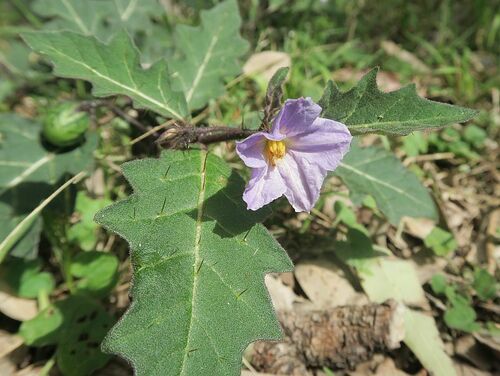
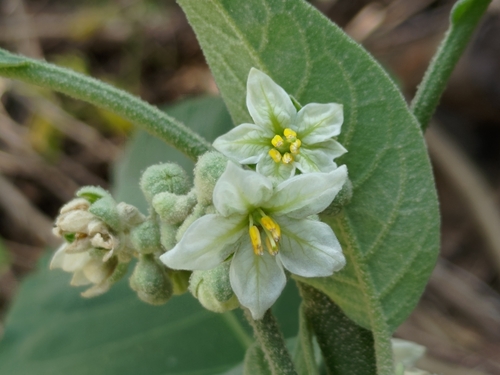
Solanum erianthum D.Don, commonly called potatotree, is a fast-growing evergreen shrub or small tree that reaches 2–8 m (6.6–26.2 ft) in height. Its trunk grows 2–5 cm (0.79–1.97 in) thick, with smooth grey or brown bark marked by lenticels, and it forms a flat-topped, spreading crown. While its wood is soft and brittle, its limbs are strong enough to support birds such as chachalacas. Its simple leaves are alternate, shaped ovate or elliptic, and measure 12–37 cm (4.7–14.6 in) long. The flowers grow in lateral cymes, and are 1.1–1.8 cm (0.43–0.71 in) in diameter; they have a five-lobed white corolla and five stamens with yellow anthers. The fruit is a yellow berry 1–1.2 cm (0.39–0.47 in) in diameter that contains many seeds. The specific epithet erianthum comes from the Greek words ἔριον (erion, meaning "wooly") and ἄνθος (anthos, meaning "flower"), referring to the dense trichomes, or hairs, that cover the flowers. Trichomes are also present on other parts of the plant, including the berries, leaves, stem tips, and petioles. Broken roots of this plant smell like cooked potatoes, and rubbing the trichomes on the leaves, stems, and petioles releases an odor similar to tar. Solanum erianthum is native to the southernmost parts of the contiguous United States (southern Florida and the Lower Rio Grande Valley of Texas), the Bahamas, Mexico, Central America, the Caribbean, and northern South America, including the Galápagos Islands. It is not found in most of South America. It is believed that Spanish explorers introduced the potato tree to the Philippines in the 16th century, and it spread from there to Malesia, Australia, and the Asian mainland. It was probably introduced to West Africa from the Caribbean via the Atlantic slave trade. Potatotree occurs at elevations from sea level to 1,500 m (4,900 ft) across a variety of habitats, including riparian zones, dry forests, and moist forests. It often grows in disturbed areas such as roadsides, fields, and waste places, and may be considered a weed. It is a ruderal species that quickly colonizes forest gaps created by treefall, and also a pioneer species that can grow on degraded mining sites before other vegetation becomes established. Like other species in its genus, S. erianthum has a range of ethnobotanical and pharmaceutical uses. This is because it contains steroidal saponins, free genins, and steroidal alkaloids from the spirosolane group, such as solasodine and tomatidine. Alkaloids make up around 0.4% of the total mass of dry berries and leaves. The steroidal alkaloids from the plant are used by the pharmaceutical industry as precursors to manufacture synthetic steroids. In traditional medicine, potatotree has many herbal medicine uses across Tropical Asia. Its leaves are thought to help the body eliminate impurities through urine, and are used to treat leukorrhea for this purpose. The leaves are also used to induce abortion; a poultice made from crushed leaves is used to treat hemorrhoids and scrofula. Heated leaves are applied to the forehead as an analgesic for headaches, and a leaf decoction is used to treat vertigo. A root decoction treats dysentery, fever, diarrhea, digestive problems, and severe body pains. The root bark is used as an anti-inflammatory and to treat arthritis. In West Africa, a leaf decoction is used to treat leprosy, sexually-transmitted diseases, and malaria, thanks to its laxative and diuretic effects. For non-medicinal uses, leaves are used in the Philippines to remove grease from dishes. The berries are toxic to humans, causing headache, cramps, and nausea, but they are cooked and eaten in Southeast Asia, and made into curry in southern India. In Tropical Asia, they are an ingredient in arrow poison. Potato tree is grown as an ornamental in the Caribbean, and works well as a shade plant for shade-grown coffee.