About Solanum donianum Walp.
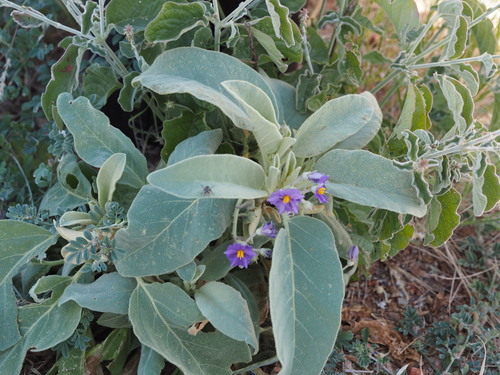
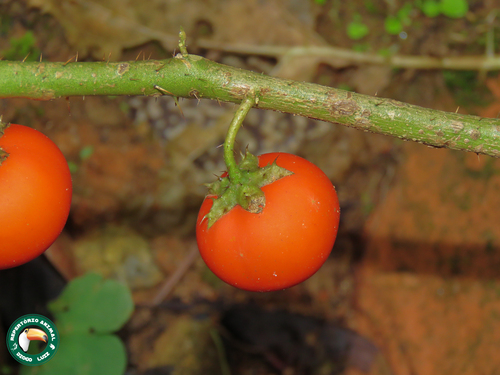
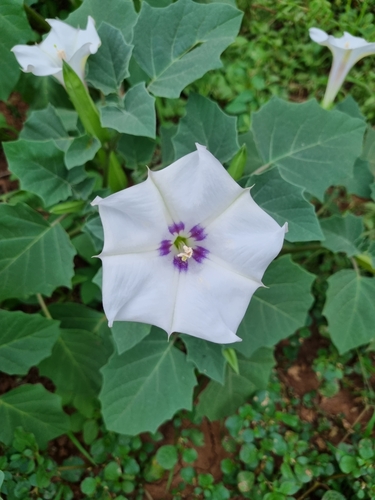
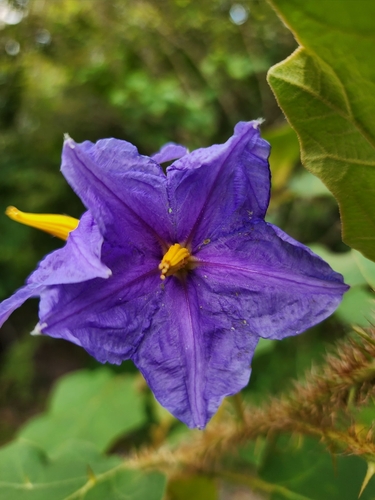
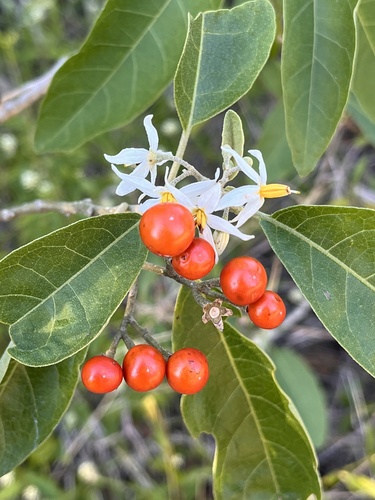
Commonly called mullein nightshade, Solanum donianum Walp. is an erect shrub that reaches up to 2.5 meters (8 feet 2 inches) in height. Young plants are sparsely covered with brownish, straight prickles that grow up to 3 mm (0.12 in) long; these prickles are often absent on older plants. All green parts of the plant are covered in a moderate to dense layer of branched, star-shaped "stellate" hairs. Leaves grow on petioles up to 3 cm (1.2 in) long. The leaf blades range from egg-shaped to elliptic, with smooth, un-toothed, un-indented margins, and reach up to 5.5 cm (2.2 in) in length. Flowers grow in heavily branched inflorescences, located at stem tips and at the nodes where leaf petioles attach to the main stem. Flowers have white petals, and their relatively large yellow pollen-producing anthers sit prominently in the center of the corolla. The fruits are fleshy red berry-type fruits, similar in appearance to small tomatoes. This species is native to Mexico, Guatemala, southern Florida, and the Bahamas. On the Yucatan Peninsula of Mexico, Solanum donianum has been recorded growing in coastal dunes, occasionally flooded low forest, medium-height semi-deciduous forest, and disturbed areas. The photographs on the source page come from an individual growing in white sand on a beach along the Caribbean coast of the Yucatan Peninsula. In warm climate regions, mullein nightshade is cultivated in butterfly gardens, used in natural landscaping, and planted for habitat restoration. It grows quickly, and spreads via rhizomes to form small patches that are wider than they are tall. Among the Maya people of Mexico’s Yucatan coast, Solanum donianum is reported to be used to treat diabetes: the fruit is blended, strained, and consumed on an empty stomach. Laboratory analysis of 12 medicinally valuable plant species used by the Yucatan Maya found that Solanum donianum has potential uses as an ACE inhibitor for high blood pressure and heart failure, as an antimicrobial for human use, and as an antifungal for plant use.