About Solanum diphyllum L.
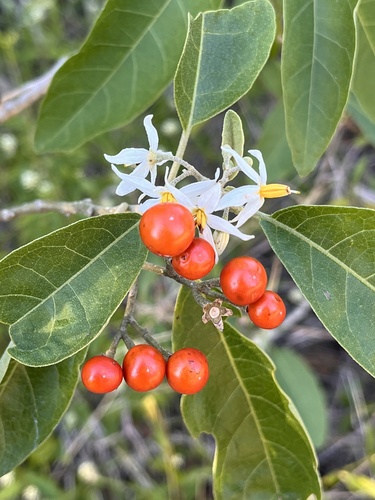
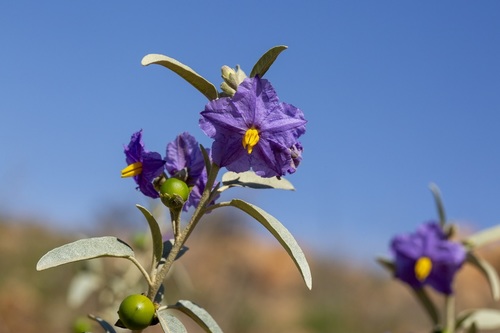
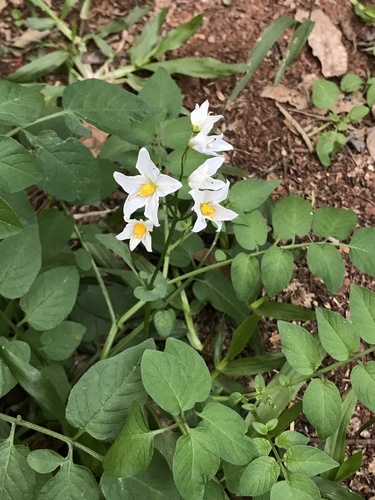
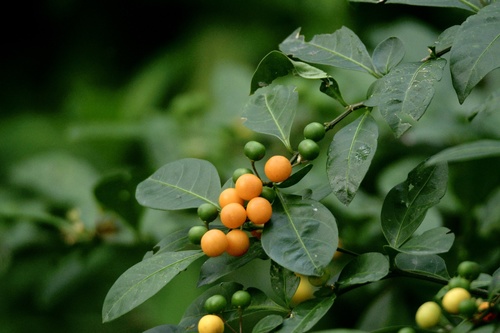
Twoleaf nightshade (Solanum diphyllum L.) grows as a small shrub reaching 1 to 2 m (3.3 to 6.6 ft) in height. Its stems have dark brown bark, and are either smooth or sometimes slightly downy. A defining characteristic of this species is that its leaves grow in pairs from a single bud, which gives it the common name 'twoleaf'. Each leaf pair consists of one larger major leaf and one smaller minor leaf. Major leaves average 6 cm (2.4 in) long by 2 cm (0.79 in) wide, with an elliptic to oblong shape. Minor leaves are smaller, more rounded, and average 2 cm (0.79 in) long by 1 cm (0.39 in) wide. The upper surface of the leaves is glossy dark green, while the underside is a lighter green. Leaf petioles are approximately 2 mm (0.079 in) long. Inflorescences grow opposite the leaves, and each holds 5 to 20 closely spaced flowers. Young flower buds are white, globular, and become lavender-colored and elongated as they mature. The open flowers are tiny, white with a lavender tinge, and measure around 1 cm (0.39 in) across. The fruits are spherical berries, with a slight groove around the middle that is especially noticeable when unripe. Young fruits are green, hard, and around 1 cm (0.39 in) in diameter. When mature, they become bright yellow to orange, fleshy, juicy, and reach about 1.2 cm (0.47 in) in diameter. The fruits sit on the flower calyces, attached to long, thin pedicels. Each berry holds numerous flattened, kidney-shaped seeds that resemble bell pepper seeds. Individual seeds measure about 3 mm (0.12 in) long and 2.5 mm (0.098 in) wide, have pale margins, and are minutely pitted. Twoleaf nightshade is native to Northern and Central America, occurring naturally in Mexico, Belize, Costa Rica, El Salvador, Guatemala, Honduras, and Nicaragua. It is widely cultivated as an ornamental plant in subtropical and tropical regions around the world, including Southern France, Italy, and Taiwan. In some areas, it has escaped cultivation and become naturalized: in Florida and Texas, United States; Java, Indonesia; the Philippines; and the West Indies. It is a ruderal species that colonizes newly disturbed lands, and also grows in mangrove forests. It is cultivated for its attractive clusters of green and yellow berries. This plant spreads very easily. Birds and bats eat its fruits, and help disperse its seeds. The seeds are particularly hardy: they can survive buried under an inch of soil for up to two years, and 75 to 85 percent of seeds will successfully sprout. Twoleaf nightshade is poisonous to humans. In areas where it is considered unwanted, the most common control method is learning its growth habits and appearance, then uprooting the plants before they produce fruit.