About Solanum chilense (Dunal) Reiche
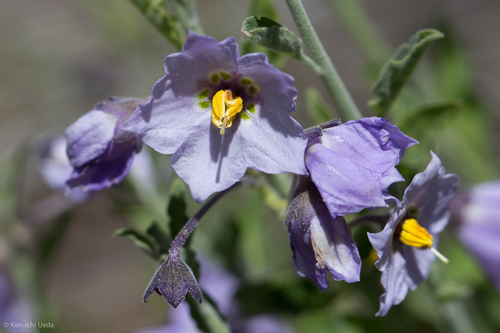
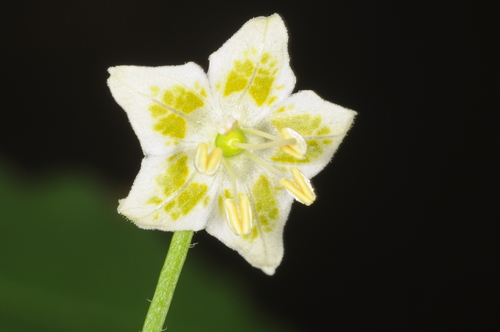
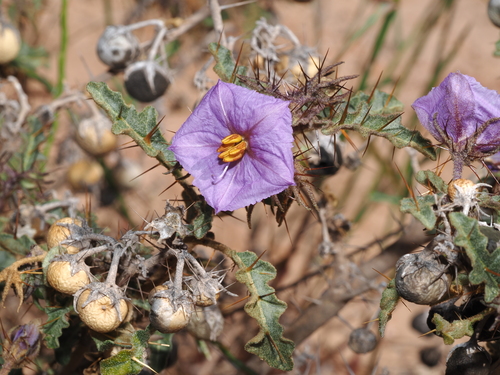
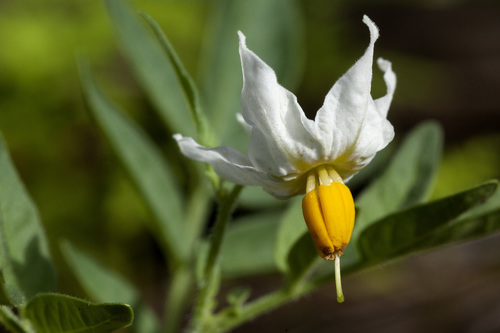
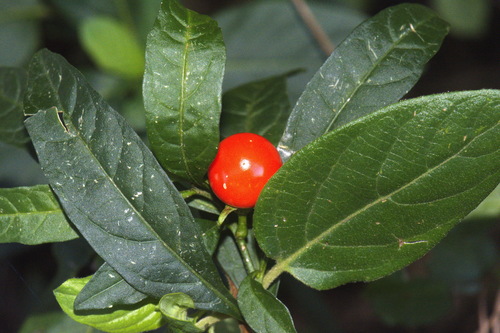
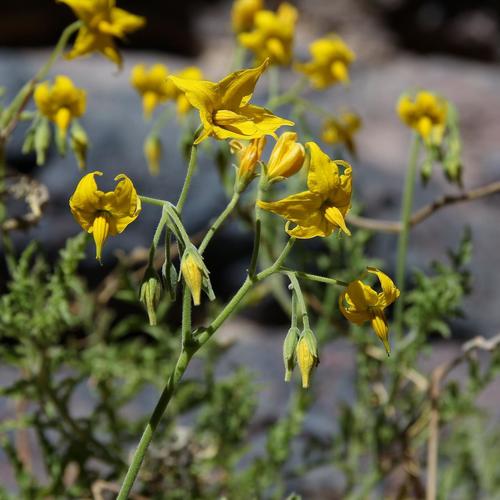
Solanum chilense (Dunal) Reiche is a perennial herb with a woody base that grows erect or decumbent, reaching 0.5–1.5 m in height and 1–4 m in width. Its grayish stems become woody at the base, with a diameter between 8 and 12 millimeters (0.31 to 0.47 inches). Stems have a dense, velvety covering made up of white non-glandular single-row trichomes up to 0.5 mm long, plus occasional short-row glandular trichomes with four-celled heads. Sympodial units most often bear two leaves, and rarely three. Internodes are 1–2 cm long, and rarely reach 5 cm. The leaves are interrupted imparipinnate, 7 to 13 cm long (rarely extending to 20 cm, often as short as 5 cm) and 2.5 to 6.5 cm wide (rarely 2 cm or 10 cm wide). They are grayish green, with a covering similar to that of stems but with fewer glandular trichomes. The leaf structure holds five to seven pairs of major leaflets, which are narrowly elliptical, have a broadly pointed to pointed tip, and tend to be sessile. For its generative characteristics, Solanum chilense produces an often terminal inflorescence holding 10–12 flowers. The flowers are pedicellate, yellow, self-incompatible, and have 5 petals. The anther tube is straight, and the stigma is capitate. Fruits are globose, 1 cm wide, green, inedible, and covered in white hairs. This species is native to northern Chile, the Galápagos, and Peru, growing at altitudes between 0 and 3300 m above sea level. It is adapted to the harsh environmental conditions and salinity of the Atacama Desert, growing in extremely dry, rocky areas and coastal deserts. Flowers and fruits are produced consistently year-round, but flowering increases noticeably between September and October. Solanum chilense is used in plant breeding because it has resistance to disease, drought, salt, and cold.