About Solanum candidum Lindl.
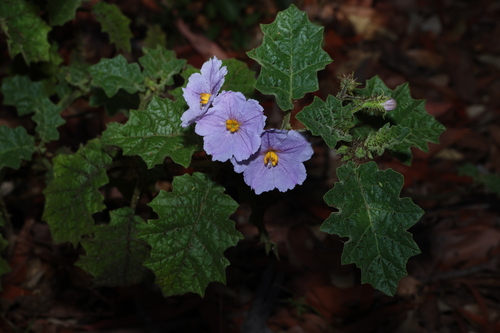
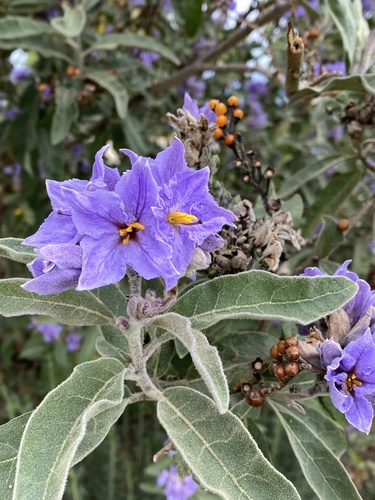
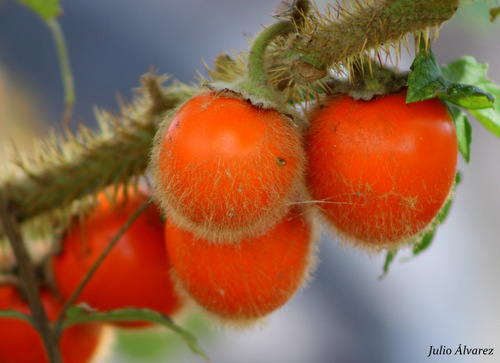
Solanum candidum Lindl. is an evergreen shrub species native to South America. It is undomesticated, very rare in cultivation, and is occasionally grown for its edible fruit. It has common names including fuzzyfruit nightshade, naranjilla silvestre and chichilegua. Its fruit is somewhat similar in appearance to the related cocona (Solanum sessiliflorum). Solanum candidum can apparently hybridize with a number of its close relatives, including cocona, naranjilla, and pseudolulo. One key difference from most of its relatives is that Solanum candidum produces extremely hirsute fruits that do not detach easily when fully ripe, making it harder to eat the ripe fruit. S. candidum is a close relative of other nightshades that are cultivated for their edible fruit, including the tomato (S. lycopersicum), the naranjilla (S. quitoense) and the eggplant (S. melongena). Compared to its more palatable cultivated relatives, S. candidum has relatively strong resistance to pests and disease, which has attracted some agricultural interest. S. candidum is also of scientific interest, as it appears to be the closest relative and a possible ancestor of Asian members of the same botanical clade. This notably includes Solanum lasiocarpum, a species native to India that is cultivated for its naranjilla-like fruits, and which also hybridizes readily with S. candidum. Solanum candidum is presumed to be native to the temperate Andean regions of Colombia, Peru and Chile. Like cocona, naranjilla, and Indian nightshade, S. candidum can produce fruit within 1 to 2 years after growing from seed. It is a short-lived perennial, and fruit production requires a fairly long growing season. This limits its agricultural potential in cooler temperate climates. Just like naranjilla and cocona, S. candidum is best adapted to subtropical cloud forest climates, where frost does not occur and extreme heat is also very rare or absent. The fruits of S. candidum are round berries that reach up to 2 cm in size. They remain covered in persistent fur even when ripe, and ripen to a yellow or red color. Ripe fruits are less juicy than more commonly cultivated edible nightshade relatives, but their flavor is reported to be appealing. Like most edible nightshades, S. candidum is attractive to common pests including aphids, white flies, beetles, and spider mites. These pests can quickly destroy naranjillas and coconas, and S. candidum is reported to have slightly higher resistance to these pests than its cultivated relatives.