About Solanum betaceum Cav.
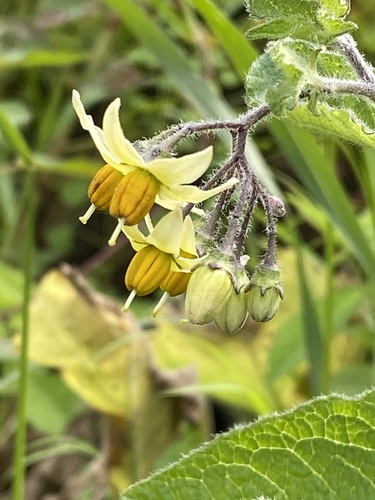
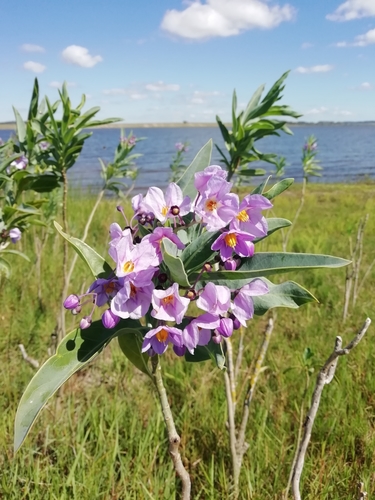
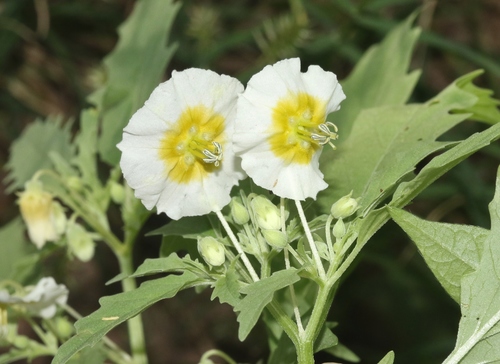
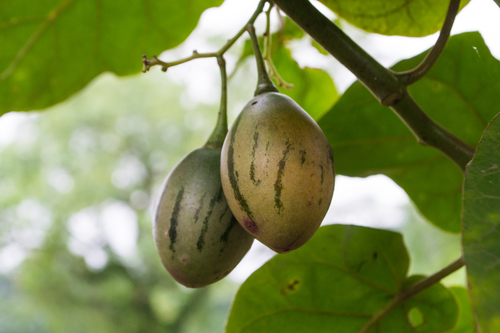
Solanum betaceum Cav., commonly known as tamarillo or tree tomato, is a fast-growing tree that reaches up to 5 meters in height. It reaches peak production after 4 years of growth, and has a total life expectancy of 5 to 12 years. The tree usually grows a single upright trunk that develops lateral branches, and both flowers and fruits hang down from these lateral branches. It has large, simple, perennial leaves that carry a strong pungent odor. Its flowers are pink-white, growing in clusters of 10 to 50 individual flowers; each cluster produces 1 to 6 fruits. This plant can set fruit without cross-pollination, but its fragrant flowers attract insects, and cross-pollination appears to improve overall fruit set. Its roots are shallow and not very extensive, which makes the plant sensitive to drought stress and prone to damage from strong winds. Tamarillos can hybridize with many other members of the Solanaceae family, though resulting hybrid fruits are sterile, and are unpalatable in some cases. This species is native to the Andes mountain region, covering Peru, Ecuador, Bolivia, Colombia, Argentina and Chile. It remains cultivated in local gardens and small orchards in this area, and is one of the most popular fruits across these Andean regions. It is now cultivated in subtropical areas worldwide, including Ethiopia, Burundi, Kenya, Rwanda, South Africa, Nepal, Hong Kong (China), Pakistan, the United States, Australia, Bhutan, New Zealand, and the Indian regions of Nagaland, Manipur, Darjeeling and Sikkim. It has also been recorded growing in Cantabria, a province in Spain. Tamarillo was first introduced to New Zealand in 1891, from seeds sourced from India, which likely originally came from Jamaica. At the time of introduction, it was called tree tomato, and became popular for growing in home gardens; small-scale commercial production was established by the 1910s. New Zealand tamarillo production peaked in the mid-1960s, and declined from the 1970s onward due to disease issues. In Colombia, tamarillo fruit is harvested year-round, with average annual production exceeding 150,000 tons. Antioquia has the largest planted area of tamarillo in the country; over 900 hectares are located in La Meseta, which supplies major Colombian cities. In 1993, New Zealand produced roughly 2,000 tons of tamarillo on 200 hectares of land, and exported the crop to the United States. After the tomato potato psyllid (TPP) was discovered in New Zealand in 2006, planted area decreased to 150 hectares by 2020. This change was matched by a drop in production volume, from 800 tonnes valued at $3.5 million, to 250 tonnes valued at $1.3 million. In 2021, growers sold 414 tonnes to domestic wholesalers for a total value of $3.1 million, and two growers exported 8 tonnes to the USA valued at $0.02 million. For export, New Zealand tamarillos use the existing marketing channels originally developed for kiwifruit. Australia’s first internationally marketed tamarillo crop was produced around 1996. Tamarillo also grows successfully at higher elevations in Malaysia, the Philippines, Ethiopia and Puerto Rico. In hot tropical lowlands, the plant only produces small fruits, and fruit set occurs very rarely. In Pakistan, tamarillo is grown on a limited experimental basis, mainly in cooler high-altitude areas such as Azad Kashmir and parts of northern Punjab. The fruit of the tamarillo is most often eaten by scooping the flesh from a halved fruit. When lightly sugared and chilled, this flesh is served as a breakfast dish. Some people in New Zealand cut the fruit in half, scoop out the pulpy flesh, and spread it on toast. Yellow-fruited cultivars have a sweeter flavor, which is sometimes compared to mango or apricot. The red-fruited variety, which is far more widely cultivated, has a tarter taste, with a much more prominent savory aftertaste. In the Northern Hemisphere, tamarillos are most commonly available from July to November; fruits harvested early in the season tend to be sweeter and less astringent. In the Ecuadorian highlands, yellow tamarillos are used in ceviche and condiments, while red varieties are used for desserts. Hydroethanolic extract from the seeds of the purple tamarillo variety has been found to be genotoxic, so macerations of this fruit should only use the pulp. Tamarillos can be made into compotes, or added to hollandaise sauce, chutneys and curries. Desserts made with this fruit include bavarois, and apple tamarillo strudel. In Colombia, Ecuador, Panama, Venezuela, and parts of Indonesia including Sumatra and Sulawesi, fresh tamarillos are often blended with water and sugar to make juice. It is also sold commercially as pasteurized tamarillo purée. In Nepal, tamarillo is very popular. It is typically eaten as a chutney or pickle during autumn and winter, where it is known locally as Tyamtar and Ram Bheda. The fruit is boiled or roasted over an open fire until the skin breaks, then mashed with chillies, timur, garlic and other chosen spices. Similar to Nepal, tamarillo is consumed in the Indian areas of Ooty, Darjeeling and Sikkim. In Northeast India, the fruit is roasted and used to make chutney blended with roasted or fried dried or fermented fish, chillies and garlic. In Ecuador, where tamarillo is called tomate de árbol, it is blended with chili peppers to make a hot sauce commonly served with Andean local dishes. This simple hot sauce is called ají, and is served with a wide range of meals across Ecuador. In Rwanda, tree tomatoes are often served alongside other tropical fruits such as mango and pineapple. In Yunnan, China, the Dai people make tamarillo nanpie, a sauce-like dish prepared with roasted tamarillo, sawtooth coriander, chillies and garlic. Tamarillo flesh is tangy and variably sweet, with a bold, complex flavor that has been compared to kiwifruit, tomato, guava, or passion fruit. The skin and the flesh directly adjacent to it are bitter, and are not usually eaten raw. The flavor of tamarillo has been described as a combination of passion fruit and piquant tomato. Red and purple fruited types are preferred by importing countries in Europe: even though they have a more acidic taste, consumers favor their color. Tamarillo fruits have a high pectin content, giving them good properties for making preserves. However, they oxidize and lose their color if not specially treated. Yellow-fruited types are better suited for industrial processing use.