About Solanum aviculare G.Forst.
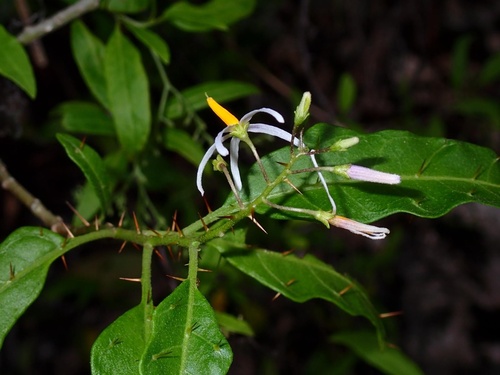
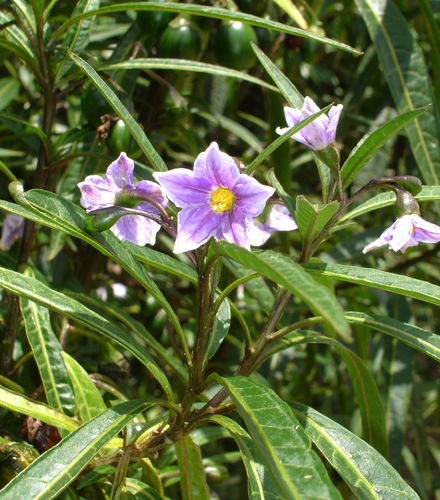
Solanum aviculare G.Forst. is an erect shrub that typically grows to a height of up to 4 m (13 ft). Its leaves take two main forms: one is lance-shaped to elliptic, 80–250 mm (3.1–9.8 in) long and 10–35 mm (0.39–1.38 in) wide; the other is sometimes lobed, broadly elliptic to egg-shaped with the narrower end towards the base, 150–300 mm (5.9–11.8 in) long, with lobes 10–100 mm (0.39–3.94 in) long and 5–20 mm (0.20–0.79 in) wide. Both sides of the leaves are the same shade of green, and each leaf has a 10–20 mm (0.39–0.79 in) long petiole. Flowers are arranged in groups of up to ten, growing from a peduncle up to 35 mm (1.4 in) long, with each flower carried on a 15–20 mm (0.59–0.79 in) long pedicel. The calyx measures 5–6 mm (0.20–0.24 in) with triangular lobes 1.5–3 mm (0.059–0.118 in) long. The petals are blue-violet and fused, forming a star-like shape 25–40 mm (0.98–1.57 in) in diameter. Flowering occurs mostly in spring and summer. The fruit is an orange-red to scarlet, oval to elliptic berry 10–15 mm (0.39–0.59 in) in diameter.
This species is native to Australia, New Zealand and New Guinea. In Australia, it is found in eastern Queensland, New South Wales (including Lord Howe Island) and Victoria, where it grows in rainforest, wet forest and rainforest margins on clay soils. Associated plant species in Australia include rainforest plants Golden sassafras (Doryphora sassafras), black wattle (Acacia melanoxylon), and lillypilly (Acmena smithii), and wet forest species brown barrel (Eucalyptus fastigata) and turpentine (Syncarpia glomulifera). In New Zealand, it occurs on both North Island, South Island and Chatham Island, where it usually grows in open shrubland up to 400 m (1,300 ft) above sea level. It has naturalised populations in South Australia, Tasmania, and Western Australia, and is possibly extinct on Norfolk Island.
Bees are thought to pollinate the flowers of Solanum aviculare. Unripe fruit of this species was traditionally boiled by Indigenous Australian communities for use as an oral contraceptive for women. The leaves and unripe fruits of S. aviculare contain the toxic alkaloid solasodine. It is cultivated in Russia and Hungary to extract solasodine, which is used as a base material to produce steroid contraceptives. Indigenous Australian communities also used the fruit as a poultice on swollen joints. The plant contains a steroid that is important for cortisone production, and it is also used as a rootstock for grafting eggplant.