About Solanum americanum Mill.
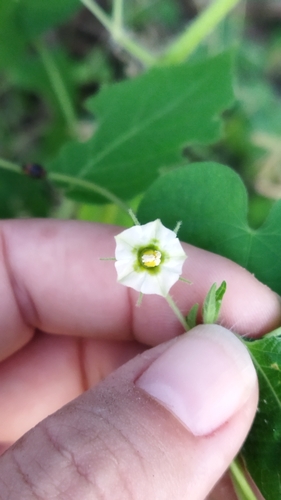
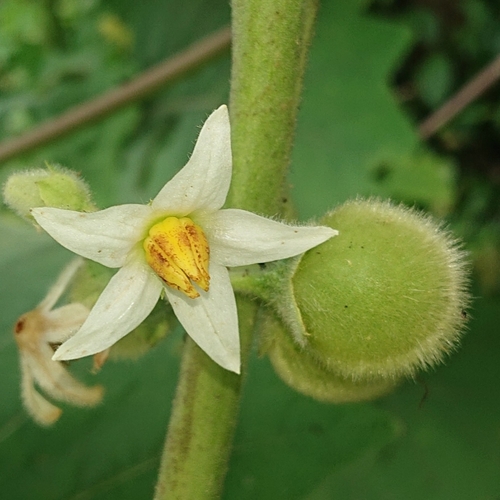
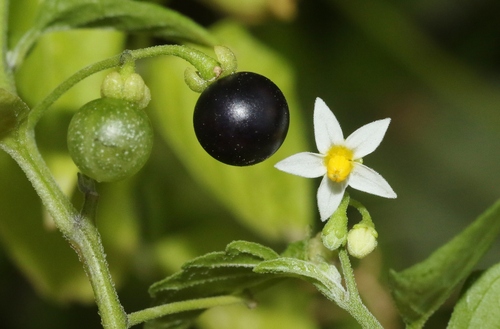
Solanum americanum Mill. is an annual or short-lived perennial plant that grows 1 to 1.5 meters (39 to 59 inches) tall. Its leaves grow alternately along branches, vary widely in size, reaching up to 10 centimeters (4 inches) long and 7 centimeters (3 inches) wide, have 4-centimeter (1 1/2-inch) petioles, and feature coarsely wavy or toothed margins. The flowers are around 1 centimeter in diameter, white or occasionally light purple, with yellow stamens. The fruit is a shiny black berry 5 to 10 millimeters (1/4 to 3/8 inch) in diameter that holds numerous small seeds.
This species has a wide but incompletely confirmed native range. Its confirmed native distribution covers the tropics and subtropics of the Americas, Melanesia, New Guinea, and Australia. It is widely naturalized across the tropical Pacific and Indian Oceans regions, including Hawaiʻi, Indochina, Madagascar, and Africa; human introduction is the likely cause of its presence in these areas.
Research has detected toxic glycoalkaloids in Solanum americanum, and authorities caution against using it as herbal medicine or food. Green unripe fruit is particularly poisonous, and consumption of unripe berries has caused child deaths. Ripe berries and foliage can also cause poisoning, though toxicity decreases somewhat as the fruit ripens. Toxicity comes from high levels of the glycoalkaloids solanine and solamargine. Other toxins in the plant include chaconine, solasonine, solanigrine, gitogenin, and traces of saponins, along with the tropane alkaloids scopolamine and hyoscyamine (an isomer of atropine). Green berries contain significant amounts of solasodine, measured at 0.65%. Ripe fruit contains 0.3 to 0.45% solasonine plus acetylcholine, and has a cholinesterase-inhibiting effect on human plasma. In Transkei, rural populations have a high incidence of esophageal cancer that is thought to be linked to consuming Solanum americanum as food. Livestock can also be poisoned by high nitrate levels in the plant's leaves. Toxicity levels vary widely based on the plant's genetic strain and local growing conditions such as soil and rainfall. One poisonous plant field guide recommends, "unless you are certain that the berries are from an edible strain, leave them alone."
Solanum americanum is used as medicine in Cameroon, Kenya, Hawaiʻi, Panama, Sierra Leone, Tanzania, and Pakistan. In China, a tea made from the whole plant is used to treat cervical cancer. It is used as folk medicine for a broad range of conditions, applied both topically and internally.