About Smithornis capensis (A.Smith, 1839)
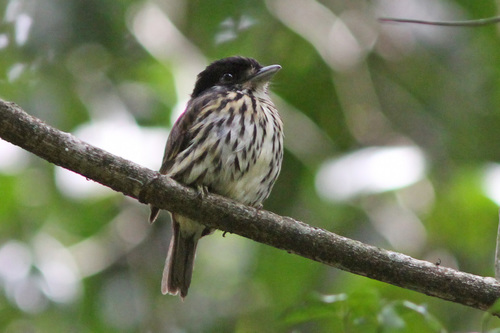
Smithornis capensis, commonly called the African broadbill, is a stocky, predominantly brown bird that looks similar to a flycatcher, with bold streaking across its body. Crown color varies by subspecies and sex: for eastern subspecies, males have black crowns and females have grey crowns, while both sexes of the subspecies S.c. meinertzhageni have blackish crowns. Its upperparts are mostly olive-brown marked with black streaks; the feather bases on the lower back and rump are white, and these bases stay hidden when the bird is at rest. Its underparts are buff or creamy-white, with black streaks across the breast and flanks. There is clear variation between subspecies: S.c. meinertzhageni and S.c. suahelicus have whiter underparts and thicker streaking compared to subspecies such as S.c. medianus. This species measures 12 to 14 centimeters (4.7 to 5.5 inches) in total length. Weight data collected in South Africa records males weighing between 21 and 26.9 grams (0.74 to 0.95 ounces), and females weighing between 17.4 and 27.5 grams (0.61 to 0.97 ounces). The African broadbill is native to Africa, with a native range concentrated in the southeastern portion of the continent. It has two separate allopatric distributions: one is a rather disjunct range in coastal West Africa, extending west from Sierra Leone east to the Central African Republic and south to Gabon and northern Congo. The main, larger distribution spans southern and eastern Africa, stretching from Kenya south to KwaZulu Natal. The African broadbill lives in the middle stratum of evergreen or lowland forest, dense deciduous thickets, and other dense woodland types, including riverine gallery forest.