About Smithiastrum prenanthoides (Durand) Morin
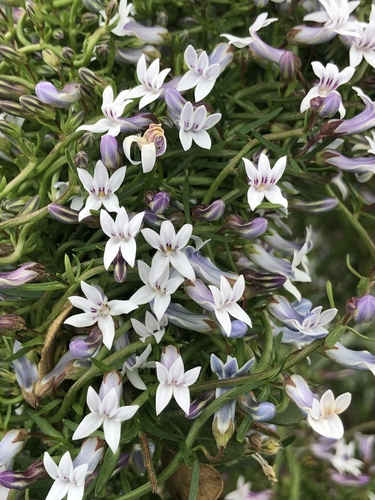
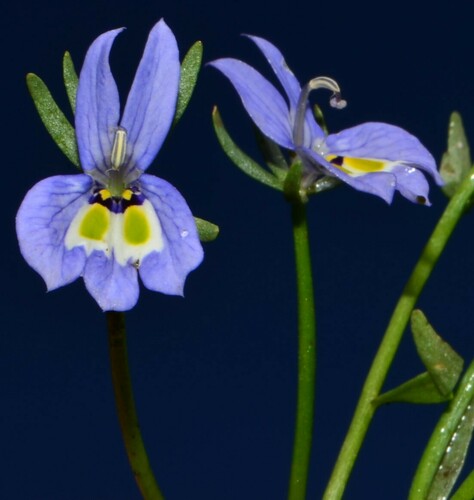
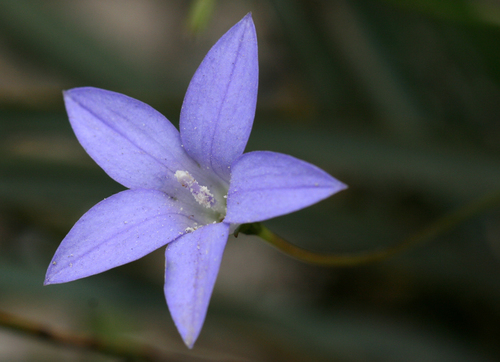
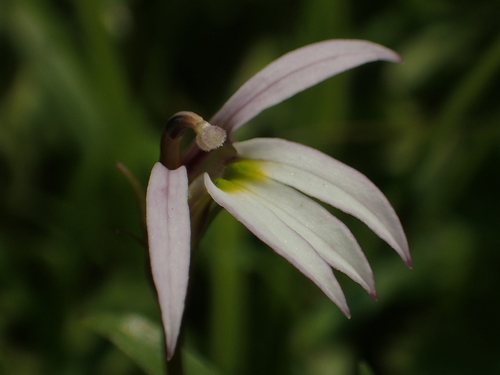
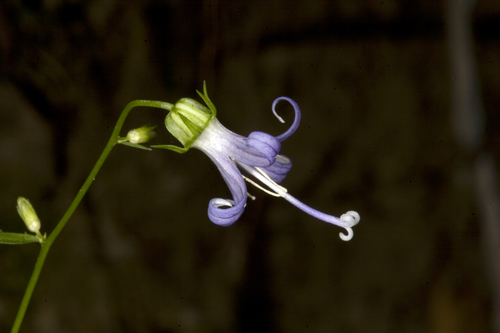
Smithiastrum prenanthoides, with the accepted scientific name Smithiastrum prenanthoides (Durand) Morin, is a perennial herb. It grows an erect, branching stem 0.6–0.9 meters high that is slightly puberulent. Its slender leaves measure 10 to 60 millimeters in length, and most have toothed margins and pointed apexes. Leaves attach to the stem via very short petioles that are usually less than 5 millimeters long, while the upper leaves on the stem are typically sessile. Leaves are wider toward their base, with two small teeth on each side. Nodding blue-purple flowers grow in groups of 3–5 arranged in a panicle. Pedicel length varies between 6 and 20 millimeters. Sepals range from spreading to reflexed, and the calyx fuses into an obconic tube that covers less than half the length of the corolla. The corolla is fused at the base, and divides into 5 slender petals with distinctly recurved tips. The stamens are 6 millimeters long, with a ciliate base. The ovary is hemispheric, 2.5–5 millimeters in diameter. The style is 15–18 millimeters long, noticeably extends out beyond the sepals and petals, and may be slightly curved. The style is also blue, and its distal half is papillate. The stigma is clavate, with 3 short curved divisions. This species blooms in June and July. Its fruit is a hemispheric dehiscent capsule with prominent ribbing. Pores are located at or below the middle of the capsule. The oblong seeds are 2 millimeters long. This species is native to California and Oregon. It grows in temperate coniferous forests across the Klamath Ranges, Cascade Range, Coastal Ranges, and a portion of the Sierra Nevadas. It occurs in association with redwood forest, yellow pine forest, red fir forest, and mixed evergreen forest, and can be found at elevations between 50 and 2000 meters. When grown in cultivation, Smithiastrum prenanthoides needs part shade and moist soil with good drainage. It can act as a host for Hyles lineata, the white-lined sphinx moth. Historically, Ohlone peoples consumed the bulbs of this plant as a winter food source.