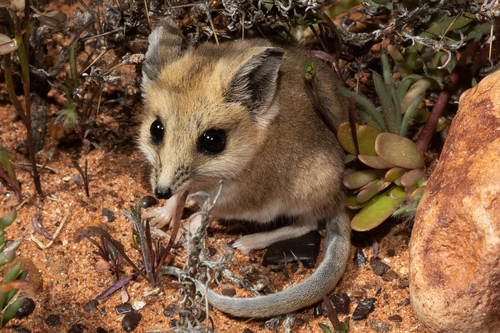
About Sminthopsis crassicaudata (Gould, 1844)
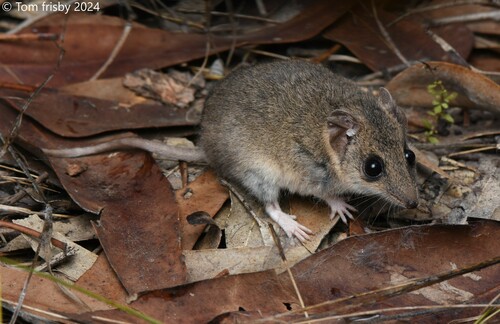
Sminthopsis crassicaudata is one of the smallest carnivorous marsupials. Its average body length is 60–90 millimeters (2.4–3.5 in), its tail measures 45–70 millimeters (1.8–2.8 in), and its ear length ranges from 14–16 millimeters (0.55–0.63 in). Adult individuals weigh between 10–20 grams (0.35–0.71 oz). Starting a few millimeters from the proximal end, the tail becomes thickened with fat, and this thickening continues all the way to the tail tip. This dunnart has trichromatic vision, which matches the vision of some other marsupials and primates, and differs from the dichromatic vision that most mammals have. This species occurs across a wide range of Australia, in a diverse set of habitats. It is absent from the Kimberley region of Western Australia, the northern Northern Territory including Arnhem Land and Kakadu National Park, and Wannon and Mallee scrub habitats in Victoria. It can be found in northeastern Victoria, in grassy woodlands and samphire shrublands. Three subspecies have distinct recorded ranges: the nominate subspecies S. c. crassicaudata occurs in Epping Forest National Park, Queensland; S. c. ferruginea occurs around Lake Eyre, South Australia; S. c. centralis occurs near Killalpannina (also spelled Killalpanima, Lake Eyre East) and near Etadunna, South Australia. Fat-tailed dunnarts inhabit most Australian deserts, including the Simpson Desert and the Gibson Desert. Suitable habitats for the species include sparse grasslands, open shrublands, and farmlands that have large areas of bare ground. Unimproved farming creates habitat that meets this species' needs, so its impact on the species is positive. Intensive agriculture is considered a negative factor for the species.