About Smilax herbacea L.
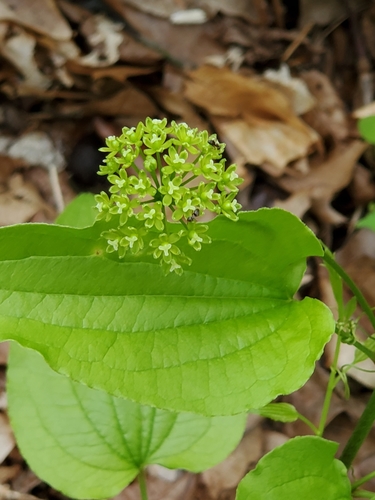
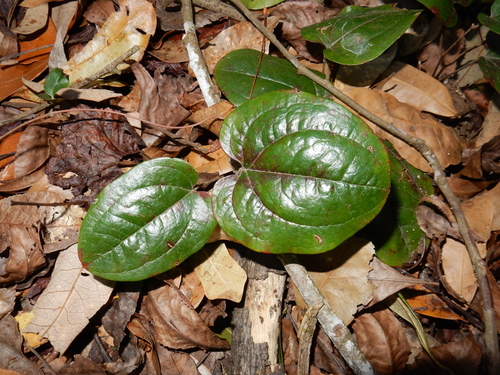
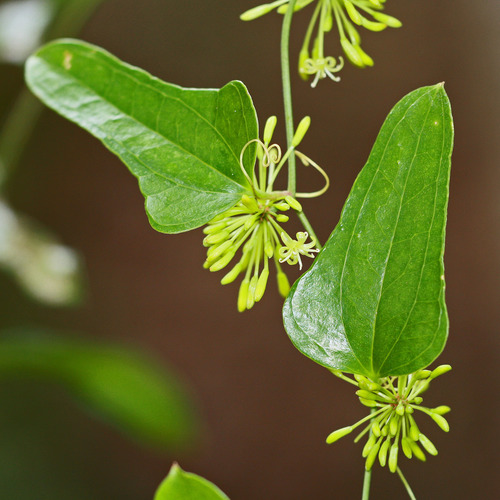
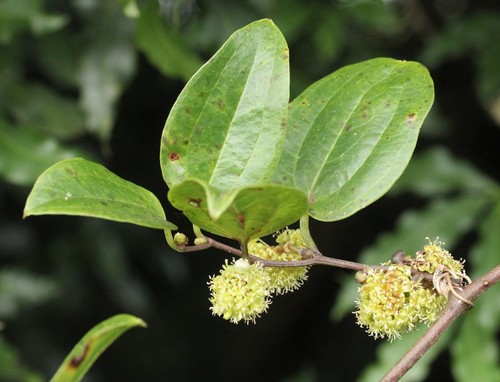
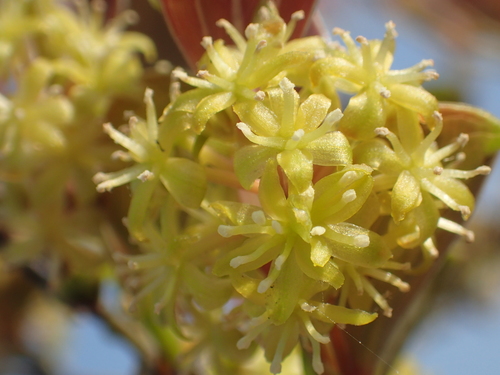
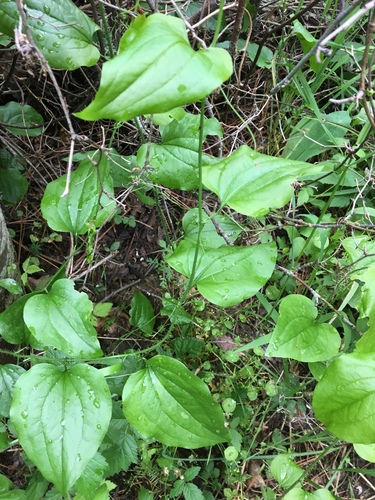
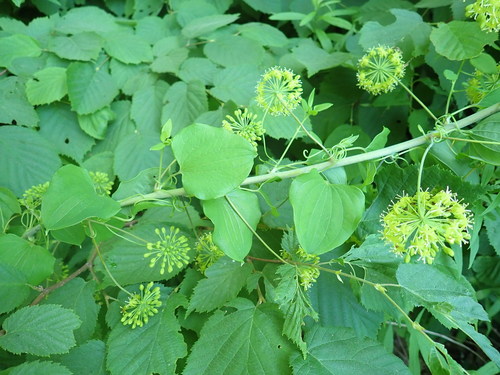
Smilax herbacea L. sends up a smooth, green shoot from a perennial rhizome each spring. As it grows, the shoot develops into a climbing vine. If a support structure is available, the vine can reach a height of 6 to 9 feet; without support, its stems will spread across the ground. Stems are typically very smooth, though some plants from certain populations may have scattered small thorns. Leaves are alternately arranged and heart-shaped, measuring 5 to 15 centimeters long, with 3 to 7 prominent veins. The upper surface of leaves is smooth and dark green, while the undersides are pale green and hairless. Leaf petioles bear short tendrils that let the vine cling to other plants or structures. The plant also produces long peduncles that can grow up to 10 centimeters in length. Smilax herbacea is native to eastern North America. In Canada, it occurs in Ontario, Quebec, and New Brunswick. In the United States, it grows in New England, Alabama, and Georgia, and can also be found in smaller quantities at higher elevations in the Midwest. It typically grows in moist, nutrient-rich habitats including deciduous forests, riparian thickets, moist meadows, lowlands, open and partially open savannas, and some forests. It can grow in clay, loam, or sandy soil as long as sufficient moisture is present. While it can tolerate shade, it prefers full or partial sun, and it is highly adaptable, able to grow in habitats with fluctuating moisture and sunlight levels. Smilax herbacea is dioecious, meaning male and female flowers grow on separate individual plants. Its flowers are arranged in spherical umbels on elongated stalks, and range in color from green to yellow-green. Individual flowers usually last around four days. Both male and female flowers have nectar glands at their bases to attract a range of pollinators. The flowers produce a strong carrion odor that specifically attracts carrion flies and beetles. The young shoots and leaves of Smilax herbacea are edible, and can be eaten either raw or cooked. Their flavor and texture are most often compared to asparagus. Ripe berries can be eaten fresh, or processed to make jelly. Roots can be dried and ground into powder, which is used as a thickening flour or starchy ingredient in many traditional indigenous foods. This species is also used medicinally by indigenous groups, including the Cherokee. It has been used to treat rheumatism and arthritis, address kidney and urinary issues, made into poultices for burns, sores, and skin eruptions, and prepared as decoctions for cramps, lung conditions, and back pain.