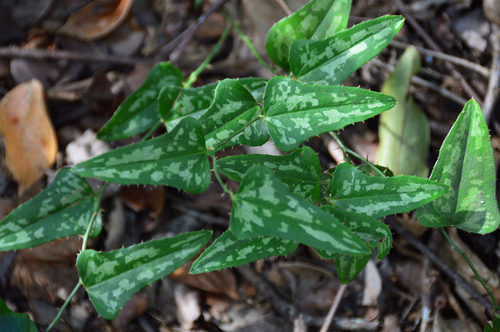
About Smilax bona-nox L.
Smilax bona-nox L., commonly called saw greenbrier, also has other common names including bullbriar, catbriar, dunes saw greenbrier, greenbriar, streychberry vine, and tramp's trouble. It is a prickly flowering vine, and is dioecious, meaning individual plants are either male or female. This species produces one-seeded, blue-black drupes as fruit. Fruits are harvested during summer and fall, and are edible to both humans and wildlife. Fruits are dispersed when wildlife eat them and excrete the seeds, primarily by small animals and songbirds, but also by deer and black bears. This plant prefers full sun and moist soil, but it can survive in partial shade, tolerates many soil types, and has high shade tolerance and medium drought tolerance. It is most commonly found in wooded disturbed areas, and has been observed in dunes, maritime forests, wetlands, and upland environments. It can grow in fine, medium, or coarse textured soils. Its range covers most of the eastern United States, extending south to southern Florida, west to the edge of Texas and eastern Mexico, north to Maryland, Kentucky, southern Indiana, southern Illinois, Missouri, and southeastern Kansas. It also grows in Bermuda and Mexico. Smilax bona-nox is tolerant of occasional controlled burns and natural fires. It has underground rhizomes, which allow it to resprout even if the above-ground portion of the plant is killed, and corm-like structures can grow alongside its rhizomes. For cultivation, Smilax bona-nox is easy to grow from seed. As a climbing vine, it needs a structure such as lattice to climb on. It should be given plenty of growing space, as it grows quickly and will shade out other plants.