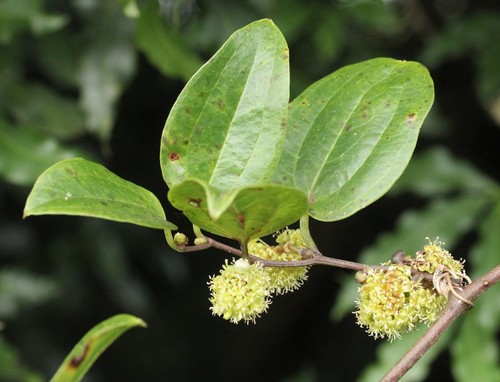
About Smilax anceps Willd.
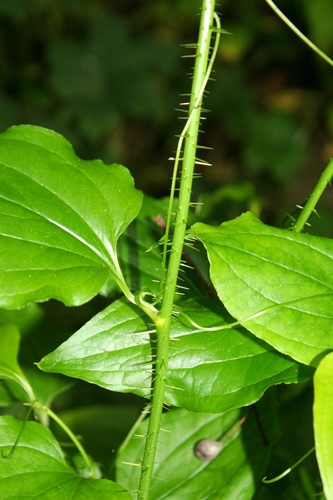
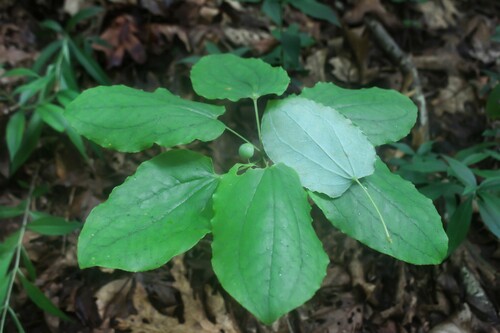
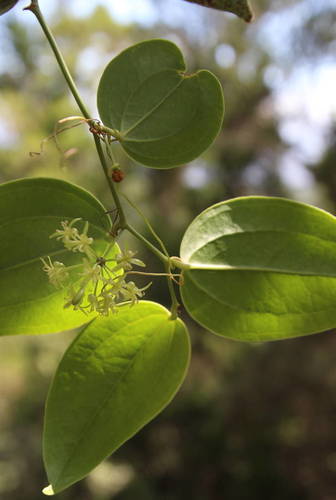
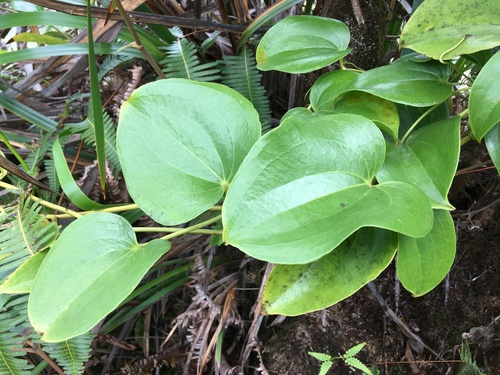
Smilax anceps Willd. is a vigorous scrambling vine or shrub, belonging to the 278 species of the genus Smilax in the plant family Smilacaceae. This species is widely distributed across Tropical Africa, Southern Africa, Réunion, Mauritius, the Comoros, and Madagascar. Its specific epithet 'anceps' comes from Latin, meaning 'dangerous', which acts as a warning about the plant's hooked prickles. The hemipteran insect Tarundia cinctipennis Stål, 1862 is known to associate with Smilax anceps. The plant has tough, fibrous stems that can reach up to 5 m in length. Stems are covered in numerous hooked prickles, and bear pairs of coiled tendrils at the base of leaf petioles. Its leaves are entire, alternate, and range in shape from ovate to elliptic to somewhat circular. They measure 4–14 cm long and have a leathery texture. Leaf petioles are 0.5–2.5 cm long, thickened, and grooved along their upper surface. Flower clusters are many-flowered axillary globose umbels. Their peduncles are around 3 cm long, and hold 2 ovate bracts roughly 5 mm long near the peduncle midpoint. All flowers in a single inflorescence are unisexual. Each flower has perianth segments 3–5 mm long, which are recurved, and can be greenish-white, yellowish, or brownish. The fruit is a globose berry 8–10 mm in diameter. It ripens through a color change from red to purplish to black, and has a slightly sweet and acidulous taste. This species was first described and published in 1806 by early German phytogeographer Carl Ludwig von Willdenow, in Species Plantarum Editio Quarto 4: 782.