About Smaragdia viridis (Linnaeus, 1758)
Scientific name: Smaragdia viridis (Linnaeus, 1758).
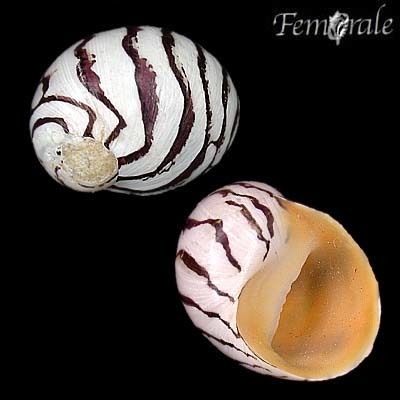
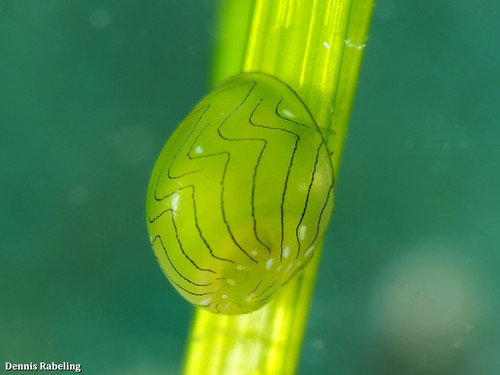
Description: The shell of this species is oval, depressed, light green with a yellowish hue, smooth and shiny. The shell often has interrupted fine bands or lines that are white, purple, or both. The shell's columellar region is greenish white, broad, and convex; its margin is curved and marked with fine teeth. One source notes a maximum shell length of 7.5 mm, while the maximum recorded shell length overall is 8 mm. The visible soft parts of the animal are the same shade of green as the shell.
Distribution: Smaragdia viridis has a disjunct distribution, with populations found in the Mediterranean Sea and the Caribbean Sea.
Ecology: This is a marine littoral species. The minimum recorded depth for the species is 0 m, and the maximum recorded depth is 20 m. Unlike many other seagrass-associated snails that feed on algal epiphytes growing on seagrasses, Smaragdia viridis feeds directly on seagrasses. The seagrass species it consumes differ across its two distribution regions. In the Mediterranean, it has been recorded feeding on Posidonia oceanica, Zostera marina, and Cymodocea nodosa. In the Caribbean, it consumes Thalassia testudinum, Halodule wrightii, and Syringodium filiforme.